Phrases, not single words.
Native speakers don’t build every sentence from scratch. A large part of fluent speech is made of ready-made phrases that people have said many times before. Learn those, and you sound natural sooner.

Why it works
Language comes down to two skills: saying what you need, and understanding what you hear. Lingophant trains exactly those two, with real people’s voices and real videos, and leaves out everything that doesn’t get you speaking.
Active vocabularyWhat you can say: phrases that come out of your mouth without thinking, with the natural melody.
Passive understandingWhat you can follow: fast, real speech you can follow and recognise structure and meaning from.
A languageTrain these two and you’re training the language itself. Grammar comes naturally.
Everyone who speaks a language learned it the same way: by listening to people a lot and by saying what they needed to say, again and again, until it came out on its own. No filling in blanks, games, points, streaks.
As adults we have one problem with this: we don’t get thousands of hours of patient people around us. So Lingophant keeps the natural method and uses technology to compress it. You hear real speech you can follow, and you practise the exact phrases you need until you can say them without thinking.
It’s more intense than tapping through a game. Your brain works harder. But every minute goes into remembering correct language or understanding real speech, so you lose less time.
First half
Native speakers don’t build every sentence from scratch. A large part of fluent speech is made of ready-made phrases that people have said many times before. Learn those, and you sound natural sooner.
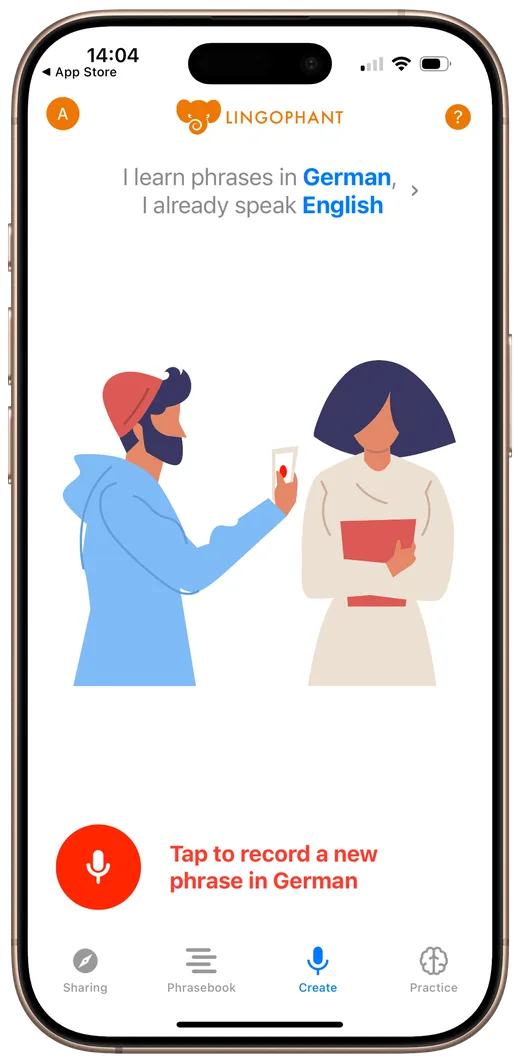
You record what you wanted to say, got wrong, or what sounded funny. So everything you practise fits your level and your life, and has a reason you learned it.
Every card keeps the speaker’s melody, rhythm, slang and emotion. You copy a real person: that’s how accents are learned and how emotions are carried.
Most native speakers are happy to help you, especially if a few weeks later you can correctly say whatever they taught you.
Every phrase you learn is a frame you can fill with other words you know. A few frames and a few endings already make many sentences. That’s why 150 phrases combine into thousands.
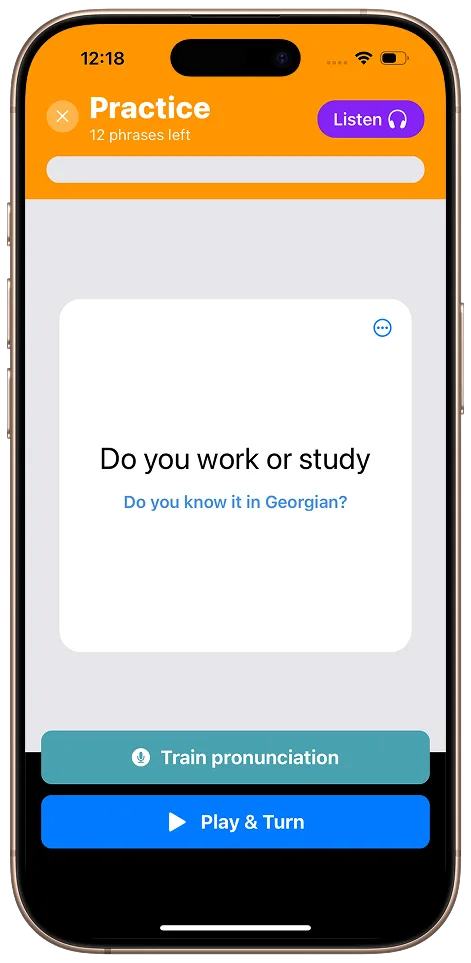
Say whether you knew it. Each time you do, the next review moves further away. Each time you don’t, the phrase stays in the loop: it goes to the back of today’s practice stack, and its future intervals get a little shorter.
Next review in 1 day. A new phrase. Did you know it?
An illustration. In the app, Lingophant calculates the days for each phrase.
Second half
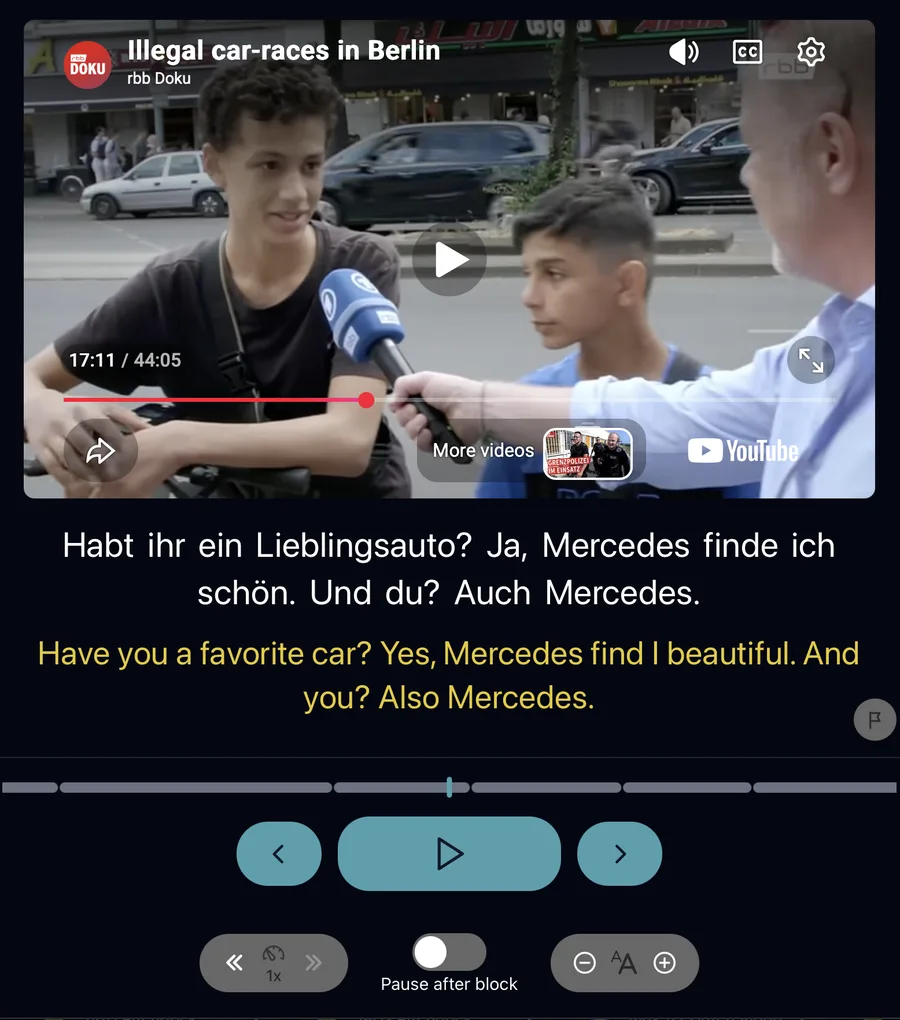
Pick a video from the country: a vlog, a cooking show, the news, a series on YouTube. Lingophant shows subtitles in the language and in yours, line by line.
You watch what you’d enjoy anyway, and you understand most of it. That’s the point: understanding lots of real language is how your feeling for grammar and your ear for fast speech grow. And you get to know the country through what its people watch.
The listening tool is free on the web at listening.lingophant.com. In the app, it keeps your recently watched videos and counts your minutes; the first 30 minutes there are free.
Grammar helps you organise what you already half-know. So for most languages we’ve summed it up in 9 key topics, each with short explanation videos if possible.
Watch them early, come back when something puzzles you. You’ll then recognise the patterns when you come across them in your phrases and videos.
A map, not the road: know the outline but get there by speaking and listening.
German, the 9 topics
The app measures two things: phrases in memory and minutes of video you’ve watched. Each phase has a goal for both.
How fast you get there depends on the time you put in. What you get there with is always the same: phrases you can say and minutes you’ve understood.
Results depend on the language and the time you put in. But a session takes 15 to 30 minutes, and it fits into time you’d lose anyway: the commute, a break, a queue. For easy languages, you can get to phase 4 in three months.
I practised Russian phrases in the metro to work every day. After 15 weeks I knew 500 phrases and had a one-hour conversation in Russian without using English.
Alex, founder of Lingophant, testing the app for years before doing any ads
Georgian took longer, as it would: a hard language. With about two hours a week, over three years, Alex knows 1000 phrases, has watched 1000 minutes, and is pretty much fluent. The totals are what count, not the calendar.
For most languages there are about ten starter phrasesets, curated videos and the grammar topics: enough to get started by yourself. On the free plan you can have 150 phrases in about six weeks.
Your partner, a neighbour, a colleague, your host. Ask them to say what you needed to say, and tap record. It takes a little courage the first time, but most people are glad you’re learning their language.
Book a teacher, online or local, and ask them to record new phrases for exactly what you need while talking. One lesson gives you practice for days. Teachers use Lingophant for free.
| What it’s good at | What Lingophant adds | |
|---|---|---|
| Duolingo and other app courses | A daily habit, a free and easy start | Phrases you need, in real voices, from day one; no reviewing what you already know |
| Anki and flashcards | Powerful spaced repetition | Cards made by recording, in seconds, with a native voice; listening in the same app |
| Tutors and classes | Speaking practice, a person who corrects you | You keep everything from the lesson, with your teacher’s voice, and practise it all week |
| YouTube on its own | Real language, free, fun | Subtitles in both languages, word lookup, and phrases you practise on top |
Lingophant combines what works, and adds learning from people: it makes every conversation and every video count.
We don’t put a number on how much faster you’ll learn. Nobody can do that honestly. Here’s what the method rests on.
Recalling something strengthens memory more than seeing it again. Practice testing is one of the two learning techniques rated “high utility” in a large review of study methods.
Roediger & Karpicke (2006), Psychological Science · paper
Dunlosky et al. (2013), Psychological Science in the Public Interest · paper
Reviews spread out over time, at growing intervals, keep things longer than the same practice crammed together. The other “high utility” technique in the same review.
Cepeda et al. (2006), Psychological Bulletin · paper
Native speakers rely on a large stock of memorised, ready-made phrases. That’s what makes them fast and sound natural.
Pawley & Syder (1983), “Two puzzles for linguistic theory”
Wray (2002), Formulaic Language and the Lexicon
Language you understand, in large amounts, is what your sense for grammar and your ear grow from.
Krashen (1982), Principles and Practice in Second Language Acquisition
And our own experience, since 2016: Russian, Georgian and the learners who wrote to us.
No. Start with the starter phrasesets, the videos and the grammar topics. People make it faster and more personal, because they record exactly what you need, but it is cheaper to learn the first phrases on your own.
30+ languages, from Spanish and German to Georgian and Japanese. The listening app transliterates foreign alphabets the same way Google Translate does it. See the Language Content Library →
Practising your phrases is free, forever. Your first 30 phrases are free, then 3 new phrases a day, and the first 30 minutes of listening in the app. Premium (about €9 a month or €60 a year; the exact price for your country is shown in the App Store or Google Play) gives you unlimited new phrases, unlimited listening in the app and your practice history. There’s no free trial. Pricing →
Keep it if it works for you. Use Lingophant for what Anki can’t do: phrases you record in seconds during a conversation, with the speaker’s voice, in addition to your listening practice.
Your phrases stay on your phone. Recordings are transcribed when you make them, by Apple or Google, where we pay extra so Google doesn’t store them. Privacy policy →
Then 3 new phrases a day. Practising what you’ve learned stays free, always.
Phrasesets, curated listening videos and grammar summaries. Content Library →
Practising is always free. For iPhone and Android.