
Learn Bulgarian

Здравей, как си? Phrases to say and videos to understand, all free to start. Time on this page counts towards your streak.
DocumentariesGrammar in 9 chapters
Phrase sets
Say it without thinking
9 sets of everyday Bulgarian, with audio for every phrase. Add a set to the app and practise it there.
- Tap “Add phrases to app”Start with set 01.
- Tap Download in the appThe phrases land on your phone, with audio.New phraseset unlockedDownload all phrases to your phone?CancelDownload
- Practise 12 at a timeThe app tests you on 12 phrases at a time and schedules the next time you see each one.12phrases per batch,
spaced repetition
- Click “Check out phrases”The phraseset page opens. Listen to every phrase there.
- Scan the QR code with your phone’s cameraThe Lingophant app opens and asks to download the set. No app yet? The link takes you to the store first.
- Practise 12 at a timeThe app tests you on 12 phrases at a time and schedules the next time you see each one.
01 · Basic Phrases
18 phrases02 · Introductions
20 phrases03 · Useful Reactions
25 phrases6 more sets: Clarifications · Learning Languages · Interests, Opinions, Preferences …
04 · Clarifications
18 phrases05 · Learning Languages
20 phrases06 · Interests, Opinions, Preferences
23 phrases07 · Travel Phrases
21 phrases08 · Smalltalk
23 phrases09 · Politeness
9 phrasesWhere all 9 sets get you: 177 phrases
Your first 30 phrases are free, then 3 new phrases a day, or Premium for as many as you like. No account needed for your first two sets.
Popular on YouTube · June 2026
Watch with two subtitles
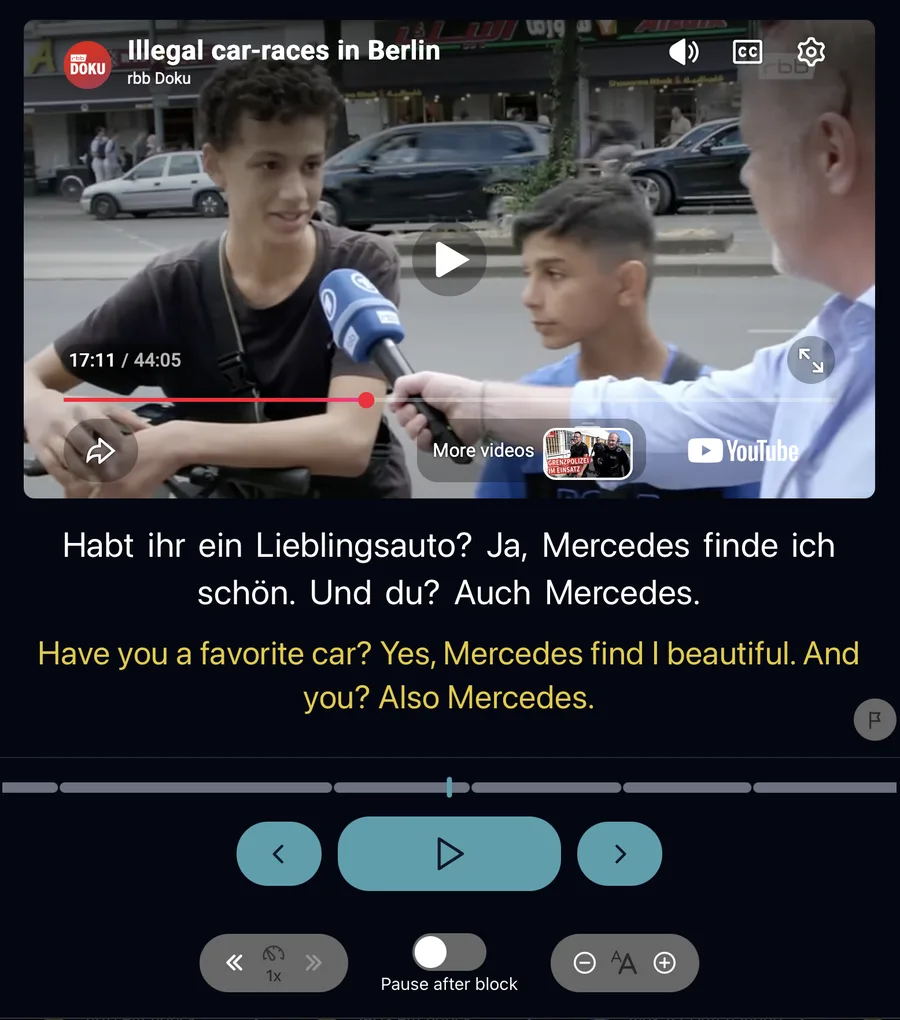
- Bulgarian in white, the translation underneath in yellow
- Tap a word to see what it means
- Slow it down, or pause after each line
 17 minИвелин Михайлов: Всички говорят за „Баба Алино“, а мълчат за ВърбицаСвободен глас · 23k views
 45 minСвършва ли времето на Европа и Украйна във войната и на САЩ с Израел в Близкия Изток?България 24 · 45k views
 36 minРеагирам на НАЙ-ДОБРИТЕ ми ПРОГНОЗИ някога за сезона в Първа Лига!!!Hristo Trichkov · 17k views
 56 minБАРЕКОВ ЕКСКЛУЗИВНО: ДЖУЛИАНИ ИСКА ЕКСТРАДИЦИЯТА НА ПЕЕВСКИДИСКУСИОНЕН ФОРУМ с Велизар Енчев · 86k views
 27 minКОПИРАМЕ ТИК ТОК ВИДЕАТА НА ISHOWSPEED!Andy Studio · 146k views
 118 minТЯ и ТОЙ с Иво Величков | Как да разберем другия, без да губим себе си?Съзнание и Смисъл · 56k views
14 more from June 2026
 17 minКАКВО ЯДЕМ?! – СЛАДОЛЕД, КОЙТО НЕ СЕ ТОПИ – Новини – Clash NewsThe Clashers · 144k views
 17 minVIRAL ТИРАМИСУ: Заслужава ли си?'Айде БГ · 53k views
 13 minСТАНА НАЙ-ЛОШОТО С ЛАДАТАDrumev BG · 103k views
 19 minНАДПРЕВАРА С КОЛЕЛА ЗА 50000 ЕВРОСветът на Ванката · 431k views
 40 minТричков на Мача на надеждата: Бербатов, Джо Харт и Стилиян Петров | Хейтър срещу Футболист S3E20Централата Спорт · 13k views
 77 minНад 350 Декара коли – Auto China 2026Bri4ka. COM · 75k views
 33 minКОЙ ЩЕ ИЗКАРА ПОВЕЧЕ ПАРИ ЗА 24 ЧАСА ? (ЛОНДОН)Martin Penev · 71k views
 34 minКУЧЕТО НИ Е БЕЗ ПАСПОРТ ! TATTSTONER & BABUNNOMAD · 49k views
 51 minНичия земя | Иманярски легенди и предания | 6 юни 2026Ничия земя · 90k views
 69 minИлияна След "Ергенът" и "Преди Обед" 🌹Kukusheff · 145k views
 23 minТрус в МВР: Оставката на Георги Кандев и мерките на Румен Радев за пътищатаДелници · 34k views
 55 min🎙️Вангел Вангелов: Бъдещето на ЦСКА е светло в следващите 50 годиниКод Спорт Подкаст с Владо и Краси · 18k views
 98 minКрай. Това беше всичко приятели! | Лига Вуцов епизод 80Sesame_Liga_Vutsov · 58k views
 17 minУчителят прекрачи границата | Жоро Игнатов | 7 юни 2026 | част 2Съдебен спор · 87k views
In the app, your first 30 minutes of listening are free. listening.lingophant.com is free in any browser.
Longer listening
Documentaries
Clear, well-edited Bulgarian, for when a short clip starts to feel easy.
София България (Bulgaria)13k subscribers · 1 video
Състраданието е мъка за чуждото нещастие, а завистта е мъка за чуждото щастие.

Богари Медия / Bogari Media11k subscribers · 5 videos
Медията на скритата истина – за нещата каквито са! Анализи на актуални събития в обществения и политически живот в България и по света…



1 more channel: ВИДИМО И НЕВИДИМО
ВИДИМО И НЕВИДИМО11k subscribers · 3 videos
„Видимо и невидимо“ е тематична линия, която води началото си от едноименната


Grammar summaries
Noticing patterns?
You’ll notice these patterns while practising phrases. Each chapter is a short explanation and the best videos we found.
A1Definite Articles (The Suffixed 'The')
Bulgarian does not have a separate word for 'the' — instead, a definite article is attached to the end of the noun itself. The suffix changes depending on the noun's gender and whether it is the subject or object of a sentence. Masculine nouns typically take -ът/-ят (full form, when subject) or -а/-я (short form, when object), feminine nouns take -та, and neuter nouns take -то. For example, 'стол' (chair) becomes 'столът' (the chair, subject) or 'стола' (the chair, object), while 'жена' (woman) becomes 'жената' (the woman).
A practical trick is to learn each new noun together with its definite form as a chunk — treat 'масата' (the table) as a single unit from the start rather than piecing it together later. Once you internalise this pattern, you will be able to identify and produce definite nouns naturally in conversation, reading menus, signs, and messages — and you will instantly understand why the ending of a noun shifts depending on where it sits in a sentence.
A1Present Tense Verb Conjugation
Bulgarian verbs conjugate according to person (I, you, he/she, we, you all, they) and belong to one of three conjugation classes (first, second, or third) determined by the vowel before the ending in the third-person singular. For example, the verb 'говоря' (to speak) follows the second conjugation: говоря, говориш, говори, говорим, говорите, говорят. Unlike English, Bulgarian drops the personal pronoun subject once context is clear, since the ending itself signals who is acting.
Focus on learning high-frequency verbs — 'съм' (to be), 'имам' (to have), 'искам' (to want), 'отивам' (to go) — as complete conjugation sets rather than one form at a time. Listening to short phrases in the app and repeating them will anchor the sound of each ending. Once you master present-tense conjugation, you can describe daily routines, ask and answer basic questions, and hold short conversations about the present — the backbone of beginner interaction.
- Verbs in Bulgarian: Personal Pronouns, Present, Past and Future Tense · Golyplot
- Verbs in Bulgarian language · 🇧🇬 Learn Bulgarian with Bistra
- Bulgarian lesson – Verbs from e-group – istudybg.com · iStudyBG
A1The Verb 'To Be' — съм
The verb 'съм' (to be) is the single most important verb in Bulgarian and is highly irregular. Its present-tense forms are: съм, си, е, сме, сте, са. It is used to state identity, nationality, profession, location, and descriptions — 'Аз съм студент' (I am a student), 'Тя е тук' (She is here). Critically, in questions and negative sentences the short clitic form shifts position: 'Не съм готов' (I am not ready), 'Той не е вкъщи' (He is not at home).
Memoise all six forms of 'съм' as a single chant early on — they are short and appear in virtually every conversation. Pay special attention to the third-person 'е', which is often contracted or spoken very lightly in fast speech. Mastering 'съм' immediately lets you introduce yourself, describe people and things, and understand a huge proportion of the sentences you will encounter on the app and in real life.
- 06 Pronouns and Verbs · Bulgarian for Beginners
- Bulgarian Grammar in 1 Hour · Learn Bulgarian with BulgarianPod101.com
A1Noun Gender and Plural Forms
Every Bulgarian noun has one of three grammatical genders: masculine, feminine, or neuter. As a rule of thumb, nouns ending in a consonant are usually masculine (стол — chair), nouns ending in -а/-я are usually feminine (книга — book, земя — land), and nouns ending in -е/-о are usually neuter (море — sea, дете — child). Gender determines which adjective endings, article suffixes, and pronoun forms are used alongside the noun. Plural formation also varies: masculine nouns often add -и or -ове, feminine nouns drop -а and add -и, and neuter nouns often swap -о/-е for -а/-ета.
Rather than memorising gender rules in the abstract, learn each new noun with its gender marker and plural as a trio — for example: 'стол (м) → столове'. Colour-coding by gender in your app notes can reinforce visual memory. Knowing noun gender unlocks agreement with adjectives and pronouns, so once this clicks, your sentences will sound grammatically natural rather than stilted.
- 04 Genders & the Definite article · Bulgarian for Beginners
- Genders and Articles in Bulgarian · Golyplot
- How To Identify Genders of Nouns In Bulgarian · Yana on Grammar
A2Adjective Agreement with Nouns
In Bulgarian, adjectives must agree with the noun they describe in gender, number, and definiteness. An adjective like 'голям' (big) changes to 'голяма' before a feminine noun, 'голямо' before a neuter noun, and 'големи' before any plural noun. When the noun is definite (takes the suffixed article), the adjective also takes a definite ending: 'голямата жена' (the big woman), 'голямото дете' (the big child). This means that changing the noun slightly will ripple through all the words around it.
The most efficient strategy is to learn adjectives inside complete noun phrases rather than in isolation — always practise 'красива жена' and 'красив мъж' together so the pattern becomes automatic. When reading or listening in the app, train yourself to spot the adjective ending and use it as a clue to the noun's gender. Once you have adjective agreement, you can give detailed descriptions of people, places, and objects, making your speech far more expressive and accurate.
A2Past Tense — The Aorist (Simple Past)
Bulgarian has several past tenses, but the aorist is the one you will use most in everyday conversation to talk about completed actions — equivalent to the English simple past ('I went', 'she called'). It is formed by adding past-tense endings to the verb stem; the exact set of endings depends on the conjugation class. For example, 'отида' (to go) in the aorist becomes: отидох, отиде, отиде, отидохме, отидохте, отидоха. An important feature is that the first- and third-person singular can look identical in some verbs, so context matters.
A useful learning technique is to take verbs you already know in the present tense and practise converting them to their aorist form in short past-tense sentences: 'Днес отивам' (Today I go) → 'Вчера отидох' (Yesterday I went). The time-marker words 'вчера' (yesterday), 'миналата седмица' (last week), and 'преди' (before/ago) are reliable signals that an aorist is coming. With the aorist in your toolkit, you can narrate past events, tell stories, and recount experiences — essential for real-world conversation.
- Learn Bulgarian – Some Past Tenses and More – Part 1/2 (Subs – Transliteration Included) · Decode Bulgarian with Ease
B1Personal Pronouns — Full and Short (Clitic) Forms
Bulgarian personal pronouns have two sets of forms for the accusative (direct object) and dative (indirect object): full (stressed) forms and short clitic forms. The full forms — 'мене' (me), 'него' (him), 'нея' (her) — are used after prepositions or for emphasis. The short clitics — 'ме', 'го', 'я', 'му', 'й' — are unstressed, one- or two-letter particles that attach before the verb in a specific position in the sentence. For example: 'Виждам го' (I see him), 'Казвам му' (I tell him). Clitics cannot appear at the very start of a sentence.
The key learning insight is to treat clitic + verb as a fixed chunk: 'виждам го', 'давам му', 'казвам ти'. When listening to native speech, the clitics are short and weakly stressed, so they are easy to miss — listen actively for them in the app's audio. Mastering pronoun clitics is a major milestone: it allows you to refer back to people and objects without repeating the noun each time, making your speech flow naturally and sound genuinely fluent.
B1Verbal Aspect — Perfective vs. Imperfective
Every Bulgarian verb comes in one of two aspects: imperfective (expressing ongoing, repeated, or incomplete actions) or perfective (expressing completed, one-time actions). Most verbs exist as pairs — 'пиша' (I write / I am writing, imperfective) vs. 'напиша' (I will write / I wrote [completing it], perfective). Aspect affects which tense forms are available: perfective verbs cannot form a present tense with present meaning, so 'напиша' in the present form automatically has a future or modal sense. This is one of the most distinctive features of Bulgarian grammar.
Rather than memorising aspect pairs as a list, learn them together as you encounter each verb — always note both forms when you add a new verb to your vocabulary. A helpful mental image: imperfective verbs capture the process (a film), perfective verbs capture the result (a snapshot). Once you grasp aspect, you will understand why Bulgarians use certain tense and mood combinations that seem unexpected from an English perspective, and your own speech will convey the right nuance about whether something is in progress, habitual, or definitively done.
B2The Renarrated Mood (Преизказно наклонение)
Bulgarian has a grammatical feature rare among European languages: the renarrated mood (преизказно наклонение), used to signal that the speaker did not personally witness the event they are describing — they heard it, read it, or it was reported to them. It is formed using the past active participle of the main verb together with the present or past forms of 'съм'. For example, 'Той дошъл' means 'He apparently came / I heard he came', contrasting with 'Той дойде' (He came — I witnessed it). Using a plain past tense for something you only heard about can sound oddly assertive to native speakers.
The best way to tune your ear to this is to notice it in news broadcasts, gossip, and storytelling — anywhere someone relays second-hand information. Listen for the -л/-ла/-ло participle ending combined with dropped or shifted 'съм' forms. Once you recognise and begin using the renarrated mood, you will be able to relay information and tell stories with precisely the right level of certainty, understand Bulgarian news and informal gossip accurately, and avoid the subtle but real social awkwardness of claiming to have witnessed things you only heard about.