
Learn Spanish (Latin America)

¿Hola como estás? Phrases to say and videos to understand, all free to start. Time on this page counts towards your streak.
DocumentariesGrammar in 9 chapters
Phrase sets
Say it without thinking
10 sets of everyday Spanish (Latin America), with audio for every phrase. Add a set to the app and practise it there.
- Tap “Add phrases to app”Start with set 00.
- Tap Download in the appThe phrases land on your phone, with audio.New phraseset unlockedDownload all phrases to your phone?CancelDownload
- Practise 12 at a timeThe app tests you on 12 phrases at a time and schedules the next time you see each one.12phrases per batch,
spaced repetition
- Click “Check out phrases”The phraseset page opens. Listen to every phrase there.
- Scan the QR code with your phone’s cameraThe Lingophant app opens and asks to download the set. No app yet? The link takes you to the store first.
- Practise 12 at a timeThe app tests you on 12 phrases at a time and schedules the next time you see each one.
00 · Baby Phrases
20 phrases01 · Basic Phrases
17 phrases02 · Introductions
21 phrases7 more sets: Useful Reactions · Clarifications · Learning Languages …
03 · Useful Reactions
26 phrases04 · Clarifications
18 phrases05 · Learning Languages
20 phrases06 · Interests, Opinions, Preferences
24 phrases07 · Travel Phrases
21 phrases08 · Smalltalk
22 phrases09 · Politeness
9 phrasesWhere all 10 sets get you: 198 phrases
Your first 30 phrases are free, then 3 new phrases a day, or Premium for as many as you like. No account needed for your first two sets.
Popular on YouTube · June 2026
Watch with two subtitles
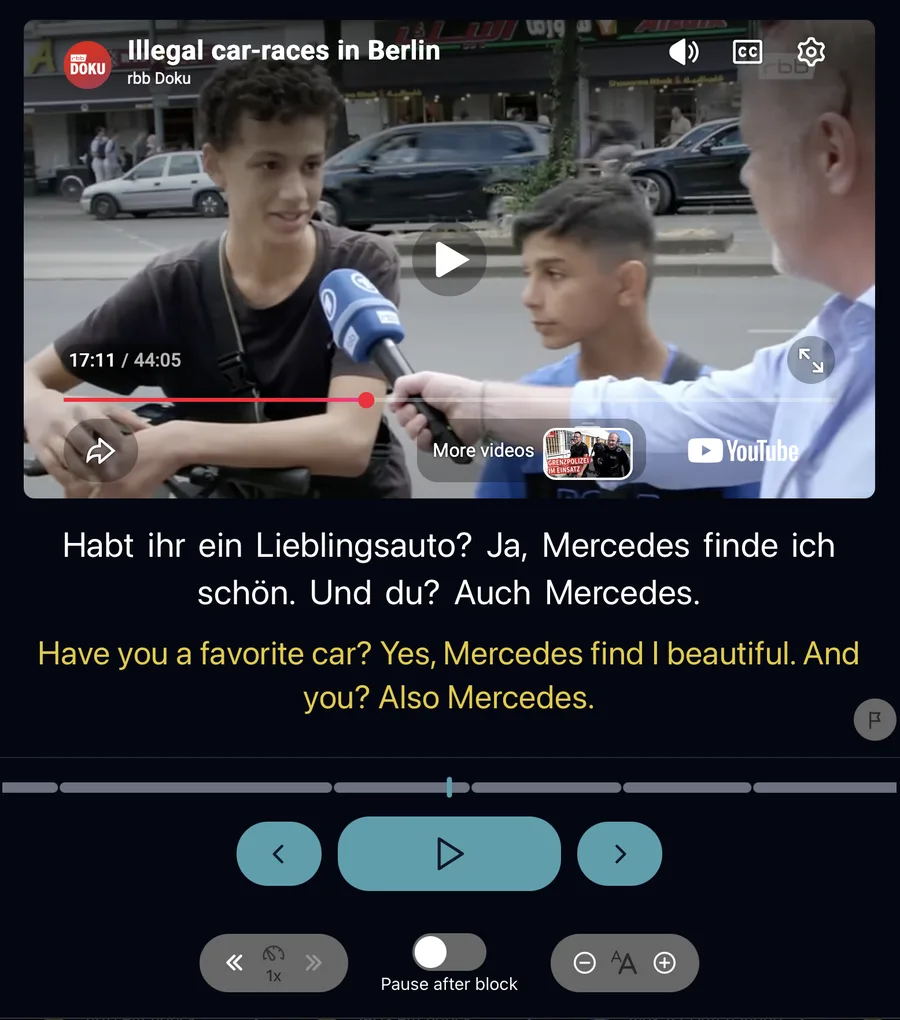
- Spanish (Latin America) in white, the translation underneath in yellow
- Tap a word to see what it means
- Slow it down, or pause after each line
 13 minMINI MINI.EXE APARECIÓ EN MI TELEVISIÓN Fede Vigevani · 9.53m views
 17 min10 PRODUCTOS ESCOLARES PROHIBIDOS EN EL COLEGIO !!Alejo Igoa · 7.37m views
 33 minAsí es trabajar en AMAZON: ¡todos los secretos de ALEXA+! 🤖Luisito Comunica · 3.16m views
 21 minEl Color es AZUL | La Décima | Cruz Azul 2 – 1 PumasClub de Futbol Cruz Azul · 322k views
 45 minMÁSCARA VS MÁSCARA – GRANDE AMERICANO VS ORIGINAL GRANDE AMERICANO – AAASomos Fox · 1.07m views
 89 minHABLANDO HUEVADAS – Duodécima Temporada [SEÑORA GANÓ 4 MILLONES DE DOLARES]Hablando Huevadas · 1.69m views
10 more from June 2026
 42 minLos HIPOPOTAMOS de PABLO ESCOBAR | DOCUMENTALLa Liendra · 1.15m views
 101 minAnecdotario 354 – Cepillin me arruinó un faje FT. Gianni PexRicardo Pérez · 641k views
 108 minAventura en la Carretera 🚗 | El Cartel y Más 💐 | Bluey – Español Canal OficialBluey – Español Canal Oficial · 1.00m views
 75 minCurso GRATIS IA – Día 2 – Crea webs y apps sin saber programarInteligencia Artificial · 168k views
 25 minNVIDIA acaba de admitir que la IA es más cara que túMoureDev by Brais Moure · 146k views
 12 minPeriféricos BUENOS BONITOS Y BARATOS #21YANPOL · 211k views
 81 minUna semana conmigo | días de primavera y Cannes con DiorbeautySilvia Muñoz de Morales · 57k views
 59 minDía de Intercambio ❤️ 1HORA de Dibujos Animados 🔍Sheriff Labrador en EspañolSheriff Labrador en Español – Dibujos Animados · 371k views
 111 minLos Periodistas – De regreso a la plaza pública (31/05/2026)Canal Once · 107k views
 14 min🔴 DW Noticias 31 de mayo: De la Espriella sorprende en Colombia y gana a Cepeda en primera vueltaDW Español · 95k views
In the app, your first 30 minutes of listening are free. listening.lingophant.com is free in any browser.
Longer listening
Documentaries
Clear, well-edited Spanish (Latin America), for when a short clip starts to feel easy.
N+ UNIVISION10.40m subscribers · 7 videos
El referente de noticias en español para la comunidad hispana en Estados Unidos.
 46 minLa Casa Blanca, familias detenidas y la crisis migratoria | Primetime – N+ Univision – 29 mayo 202630k views
 32 minGobierno lanza portal para denunciar inmigrantes | Edicion Digital 29 de mayo de 202616k views
 20 minGobierno aclara reglas de residencia | Edicion Digital 1 de junio de 202612k views
4 more from N+ UNIVISION
 22 minCifras récord en suicidios de inmigrantes bajo custodia de ICE | Edicion Digital 27 de mayo de 20263k views
 31 minConferencia del Tesoro: Scott Bessent anuncia las 'Trump Accounts' y el plan del nuevo billete3k views
 22 min¿Tu residencia estaría en riesgo? | Edicion Digital 1 de junio de 20263k views
 48 minElecciones entre el miedo y la violencia en Colombia | Primetime – N+ Univision – 1 de junio 2026701 views
EL COMERCIO1.64m subscribers · 3 videos
Bienvenidos al canal de YouTube de El Comercio, un lugar donde podemos conversar sobre el acontecer nacional y mundial, así como…
 46 minDocumental COVID-19: 100 días de la pandemia del coronavirus gana premio | El Comercio | VideosEC501k views
 66 minElecciones 2021: Análisis de planes de Gobierno en seguridad ciudadana | El Comercio | VideoEC842 views
 27 minElecciones 2021: Analistas evalúan desarrollo de la jornada electoral | El Comercio | VideosEC831 views
3 more channels: Nat Geo en Español · GeoDocs – Español · Bianca Graulau Español
Nat Geo en Español1.52m subscribers · 10 videos
Un paso a lo maravilloso! Bienvenidos al canal oficial de National Geographic en Español.
 44 minEl Chapo Guzmán | Episodio Completo17.14m views
 44 minDe Glaciares a Selvas: Un Recorrido por Sudamérica | Nat Geo en Español4.02m views
 44 minDescubriendo los Secretos de la Ciudad Perdida Maya | Tesoros Perdidos | Nat Geo en Español2.94m views
7 more from Nat Geo en Español
 47 minLas Fuerzas Más Destructivas de la Tierra | Secreto en los Océanos | Nat Geo en Español14.49m views
 47 minLos Sistemas Ocultas de la Tierra | Nuestro Planeta | Nat Geo en Español2.26m views
 47 min¿Dios Habla a Través de Visiones? | Historia de Dios | Nat Geo en Español6.34m views
 44 minEl Burj Khalifa | Megaestructuras: Maravillas de la Ingenieria | Nat Geo en Español7.39m views
 50 minPerros Salvajes: Cachorros en Peligro | Reino Salvaje | Nat Geo en Español5.34m views
 47 minSecretos Mortales: Norteamérica | Secreto en los Océanos | Nat Geo en Español2.28m views
 132 minEn Primera Persona: Megaepisodio | Nat Geo en Español2.14m views
GeoDocs – Español155k subscribers · 13 videos
¡Sean bienvenidos a nuestro canal dedicado a documentales que revelan las maravillas del mundo, sus culturas fascinantes y la riqueza de la…
 32 minCOLOMBIA: Corazón Salvaje de América [Documental Completo]711k views
 30 minCorazón indomable de los Andes [Documental Completo]279k views
 42 minPATAGONIA: Reino Salvaje [Documental Completo]207k views
10 more from GeoDocs – Español
 32 minANIMALES PELIGROSOS DE LA SELVA AMAZÓNICA [DOCUMENTAL]1.10m views
 33 minOCÉANO PACÍFICO: Depredadores Brutales [Documental]6.14m views
 34 minEste Video Cambiará Tu Visión | Documental | Irán3.38m views
 30 minSIBERIA: Territorio Extremo [Documental Completo]2.31m views
 32 minFenómenos Increíbles de la Naturaleza [Documental]2.78m views
 25 minDEPREDADORAS DEL CIELO: Atacan Sin Piedad | DOCUMENTAL230k views
 26 minMIGRACIONES SALVAJES: Las Más Peligrosas Del Mundo [Documental]5.97m views
 36 minTURQUÍA: Territorio Indomable [Documental Completo]205k views
 43 minSUDÁFRICA: La Última Frontera Indómita [Documental Completo]389k views
 32 minEste Video Cambiará Tu Visión | Documental | India598k views
Bianca Graulau Español35k subscribers · 10 videos
Reportajes de temas de Puerto Rico y el mundo en español.
 40 minEl Jíbaro Boricua Alimentaba a Puerto Rico ¿Qué pasó?28k views
 45 min¿Sufrimos de Mente Colonizada en Puerto Rico?15k views
 31 min“Estamos Aquí” | Rescatando las Costumbres Indígenas de los Boricuas8k views
7 more from Bianca Graulau Español
 37 minSe Enfrentaron a un Inversionista de la Ley 22 y Esto Fue lo que Pasó9k views
 51 minCómo Empezar a Crear Comunidad14k views
 29 minMédico habla de los problemas con las aseguradoras de Puerto Rico28k views
 31 minDefendieron Estas Cuevas y Ahora Te Invitan a Visitarlas4k views
 45 minEl Duelo de Perder a un Ser Querido: Entrevista con un Doula de Final de Vida3k views
 29 minPartera: “Se hacen demasiadas cesáreas en Puerto Rico.”2k views
 38 min¿Alternativa al Lucro Desmedido?10k views
Grammar summaries
Noticing patterns?
You’ll notice these patterns while practising phrases. Each chapter is a short explanation and the best videos we found.
A1Ser vs. Estar (Two Ways to Say 'To Be')
Spanish has two verbs that both translate as 'to be' in English: ser and estar. Ser is used for permanent or defining characteristics — identity, nationality, profession, and inherent qualities (e.g., 'Soy mexicano' — I am Mexican; 'Ella es doctora' — She is a doctor). Estar is used for states, conditions, locations, and feelings that are temporary or changeable (e.g., 'Estoy cansado' — I am tired; 'Estamos en la ciudad' — We are in the city). The same adjective can change meaning depending on which verb you use: 'Es aburrido' means he is a boring person, while 'Está aburrido' means he is bored right now.
A helpful trick is to link estar with the acronym FELT + Location: Feelings, Emotions, Location, and Temporary states. Everything else tends to be ser territory. Practice by noticing which verb appears in the phrases you study on the app and asking yourself why. Once you internalize this split, you will sound dramatically more natural and avoid one of the most common errors English speakers make in everyday Spanish conversation.
- When to Use Ser or Estar | Spanish For Beginners (Ep.2.5) · AIB
- Ser or estar? [Speaking Spanish] · Butterfly Spanish
- Ser vs Estar: Spanish Lesson #3 · BaseLang
A1Present Tense: Regular & Key Irregular Verbs
The present tense in Spanish is used far more broadly than in English — it covers what is happening now, habitual actions, and even near-future plans ('Mañana trabajo' — I work tomorrow). Regular verbs follow predictable endings for three groups: -ar verbs like hablar (hablo, hablas, habla…), -er verbs like comer (como, comes, come…), and -ir verbs like vivir (vivo, vives, vive…). However, the highest-frequency verbs — tener (to have), ir (to go), querer (to want), poder (to be able), hacer (to do/make), and venir (to come) — are irregular and must be memorized as they appear constantly in real speech.
Rather than drilling full conjugation tables in isolation, learn irregulars through chunked phrases you already use: 'tengo que…' (I have to…), 'quiero un…' (I want a…), 'puedo ayudarte' (I can help you). These high-frequency chunks will embed the forms naturally. Mastering the present tense unlocks the ability to talk about your daily life, express needs and desires, and hold basic conversations on virtually any everyday topic.
- Irregular Verbs in Spanish in the Present Tense: Conjugation and Examples · Spanish Learning Lab
- Irregular Verbs in Spanish | The Language Tutor *Lesson 21* · The Language Tutor – Spanish
- Spanish conjugation animated explanation video · Lingo Learner
A1Noun Gender & Adjective Agreement
Every Spanish noun is either masculine or feminine, and this gender affects the articles and adjectives that accompany it. Masculine nouns typically use el/un (el libro — the book) while feminine nouns use la/una (la mesa — the table). Adjectives must match the noun in both gender and number: 'un chico alto' (a tall boy) becomes 'una chica alta' (a tall girl), and in the plural 'chicos altos' / 'chicas altas'. Most nouns ending in -o are masculine and most ending in -a are feminine, though there are important exceptions like 'el día' (masculine) and 'la mano' (feminine).
The most effective strategy is to always learn a new noun together with its article — store it as 'la mesa' not just 'mesa'. This turns gender into a memory feature of the word itself rather than a separate rule to recall under pressure. Once this agreement becomes automatic, your Spanish will sound polished and connected, and you will be able to build descriptive sentences — describing people, places, and objects — with natural fluency.
- Noun-Adjective Agreement in Spanish · Sra. Westerman
- EL? LA? How to choose the correct gender in Spanish – All You Need to Know About Spanish Articles · My Daily Spanish
- Learn Spanish: Number & Gender Agreement for Spanish Nouns Adjectives and Articles · Learn Spanish TV
A2Preterite Tense (Completed Past Actions)
The preterite (pretérito indefinido) is the primary past tense used in Latin American conversation to talk about actions that are completed and viewed as finished events: 'Fui al mercado' (I went to the market), 'Comimos tacos' (We ate tacos), 'Ella llamó ayer' (She called yesterday). Regular -ar verbs take endings like -é, -aste, -ó, -amos, -aron, while -er/-ir verbs use -í, -iste, -ió, -imos, -ieron. Several very common verbs — ser/ir (both become fui), tener, estar, hacer, poder — have irregular preterite stems that simply need to be learned.
Focus first on the third-person singular (-ó / -ió) and first-person singular (-é / -í) forms, since these come up most in storytelling and recounting events. Notice time markers like ayer (yesterday), la semana pasada (last week), and hace un momento (a moment ago) — they are reliable signals that the preterite is coming. Internalizing this tense lets you recount experiences, tell stories, and talk about your past in real conversations — an essential ability for connecting with people.
A2Gustar-Type Verbs (Expressing Likes & Feelings)
The verb gustar and a family of similar verbs — encantar (to love), molestar (to bother), parecer (to seem), doler (to hurt), faltar (to be missing) — work differently from typical verbs. Rather than 'I like tacos,' Spanish says the equivalent of 'Tacos please me': 'Me gustan los tacos.' The verb agrees with the thing doing the pleasing (tacos, plural), not with the person. The person is indicated by an indirect object pronoun: me (me), te (you), le (him/her/you formal), nos (us), les (them/you all). So 'Me gusta la música' (I like music) vs. 'Le duele la cabeza' (His/her head hurts).
Think of it as the subject and verb being flipped compared to English. A practical trick: always start by choosing the correct pronoun (me/te/le/nos/les), then pick gusta or gustan based on whether what follows is singular or plural. This structure is everywhere in daily Latin American Spanish — used to express preferences, complaints, needs, and opinions. Mastering it lets you talk about what you enjoy, what bothers you, and how you feel, which forms the backbone of casual, personal conversation.
- Verbs Like Gustar · The Spanish Dude
- How to use Gustar: Easy animated visual explanation for beginners with Spanish examples and practice · Lingo Learner
- Verbs Like Gustar (including 5 Must-Know Verbs) · Real Fast Spanish
A2Reflexive Verbs & Daily Routine
Reflexive verbs in Spanish describe actions done to or for oneself, and they are marked by reflexive pronouns: me, te, se, nos, se. Many daily-routine verbs are reflexive: levantarse (to get up), bañarse (to shower), vestirse (to get dressed), llamarse (to be called), sentirse (to feel). The pronoun goes before a conjugated verb ('Me levanto a las siete' — I get up at seven) or can attach to an infinitive ('Voy a bañarme' — I'm going to shower). Beyond daily routines, reflexive constructions signal reciprocal actions ('Nos queremos' — We love each other) and emotional states ('Me alegro' — I'm glad).
The best way to internalize reflexives is to narrate your own morning routine aloud using these verbs — it is repetitive and predictable, which makes the pronouns stick quickly. Watch for the -se ending on infinitives in the app as your cue that a verb behaves reflexively. Once you have these down, you can describe your daily life, talk about how you feel, and understand a huge range of sentences that would otherwise seem mysterious.
- Talk About Your Daily Routine in Spanish || Use Reflexive Verbs and Pronouns · Why Not Spanish?
- Daily routine in Spanish (2020) Mi Rutina – Mi Routine – Reflexive Verbs · Teacher Catalina
- Learn Spanish Grammar – Reflexive Verbs in Spanish · Butterfly Spanish
B1Object Pronouns (Lo, La, Le, Me, Te…)
Object pronouns replace nouns to avoid repetition and are essential for flowing, natural Spanish. Direct object pronouns answer 'what?' or 'whom?': lo (it/him/masculine), la (it/her/feminine), los, las. Indirect object pronouns answer 'to/for whom?': me, te, le, nos, les. In Latin American speech, le and les are used as indirect objects even when referring to people (rather than the 'leísmo' of Spain). These pronouns almost always come directly before the conjugated verb: '¿El libro? Ya lo tengo' (The book? I already have it). When combined, indirect comes first: 'Te lo doy' (I give it to you), and le/les become se before lo/la: 'Se lo expliqué' (I explained it to him).
The key insight is to listen for these small words right before verbs in the app's audio — they are easy to miss but carry critical meaning. A useful drill is to take a sentence and mentally substitute the noun with the right pronoun. Once you handle object pronouns smoothly, your Spanish stops sounding like translated English: you can give things, ask for things, and talk about people without repeating nouns awkwardly, which is a hallmark of genuine fluency.
B1Present Subjunctive: Wishes, Doubts & Recommendations
The subjunctive mood feels intimidating but its core uses appear constantly in spoken Latin American Spanish. It is triggered in subordinate clauses after expressions of desire, emotion, doubt, or recommendation — essentially when one subject influences or reacts to another. Common triggers include: quiero que (I want you to…), espero que (I hope that…), es importante que (it's important that…), no creo que (I don't think that…), and te recomiendo que (I recommend that you…). The present subjunctive is formed by taking the yo present-tense form, dropping the -o, and adding 'opposite' endings (-e endings for -ar verbs, -a endings for -er/-ir verbs): hablar → hable, comer → coma, vivir → viva.
Rather than memorizing abstract rules, learn the subjunctive by anchoring it to the trigger phrases you encounter in the app — treat 'quiero que + subjunctive' as a fixed chunk at first. Listen for it especially in recommendations, instructions, and expressions of feeling. Once you recognize and produce this structure, you unlock the ability to express nuanced ideas: hopes, advice, doubts, and emotional reactions — the kind of language that moves conversations beyond simple facts into real personal expression.
- Introduction to the Present Subjunctive in Spanish · Señor Jordan
- The Subjunctive in Spanish | The Language Tutor *Lesson 58* · The Language Tutor – Spanish
- Learn the Spanish Subjunctive in 10 Minutes · Tell Me In Spanish
B2Imperfect vs. Preterite (Two Past Tenses)
While the preterite marks completed events, the imperfect (pretérito imperfecto) describes ongoing states, habitual past actions, background context, and descriptions in the past. Regular imperfect endings are highly consistent: -ar verbs take -aba, -abas, -aba, -ábamos, -aban; and -er/-ir verbs take -ía, -ías, -ía, -íamos, -ían. Only three verbs are truly irregular: ser (era), ir (iba), and ver (veía). In storytelling, the two tenses work as a team: the imperfect sets the scene ('Llovía y hacía frío' — It was raining and cold) while the preterite advances the plot ('De repente, sonó el teléfono' — Suddenly, the phone rang).
A vivid way to remember the distinction: think of the preterite as a photograph (a single captured moment) and the imperfect as a video (ongoing, continuous). Time expressions help too — 'siempre,' 'todos los días,' and 'cuando era niño' signal the imperfect, while 'ayer,' 'de repente,' and 'una vez' signal the preterite. Mastering this contrast allows you to tell stories and anecdotes with the same natural rhythm that native speakers use, painting background scenes while moving the action forward — a defining feature of confident, expressive Spanish.
- Spanish Past Tense: Preterite Vs. Imperfect, Rule of Thumb · The Spanish Dude
- Using the Preterite and Imperfect to Tell Stories in Spanish · Spanish With Qroo Paul
- PRETERITE VS IMPERFECT | Spanish Past Tense · Speak Spanish Faster