
Learn Portuguese (Portugal)

Olá, como estás? Phrases to say and videos to understand, all free to start. Time on this page counts towards your streak.
DocumentariesGrammar in 9 chapters
Phrase sets
Say it without thinking
9 sets of everyday Portuguese (Portugal), with audio for every phrase. Add a set to the app and practise it there.
- Tap “Add phrases to app”Start with set 01.
- Tap Download in the appThe phrases land on your phone, with audio.New phraseset unlockedDownload all phrases to your phone?CancelDownload
- Practise 12 at a timeThe app tests you on 12 phrases at a time and schedules the next time you see each one.12phrases per batch,
spaced repetition
- Click “Check out phrases”The phraseset page opens. Listen to every phrase there.
- Scan the QR code with your phone’s cameraThe Lingophant app opens and asks to download the set. No app yet? The link takes you to the store first.
- Practise 12 at a timeThe app tests you on 12 phrases at a time and schedules the next time you see each one.
01 · Basic Phrases
18 phrases02 · Introductions
21 phrases03 · Useful Reactions
26 phrases6 more sets: Clarifications · Learning Languages · Interests, Opinions, Preferences …
04 · Clarifications
18 phrases05 · Learning Languages
20 phrases06 · Interests, Opinions, Preferences
24 phrases07 · Travel Phrases
21 phrases08 · Smalltalk
22 phrases09 · Politeness
8 phrasesWhere all 9 sets get you: 178 phrases
Your first 30 phrases are free, then 3 new phrases a day, or Premium for as many as you like. No account needed for your first two sets.
Popular on YouTube · June 2026
Watch with two subtitles
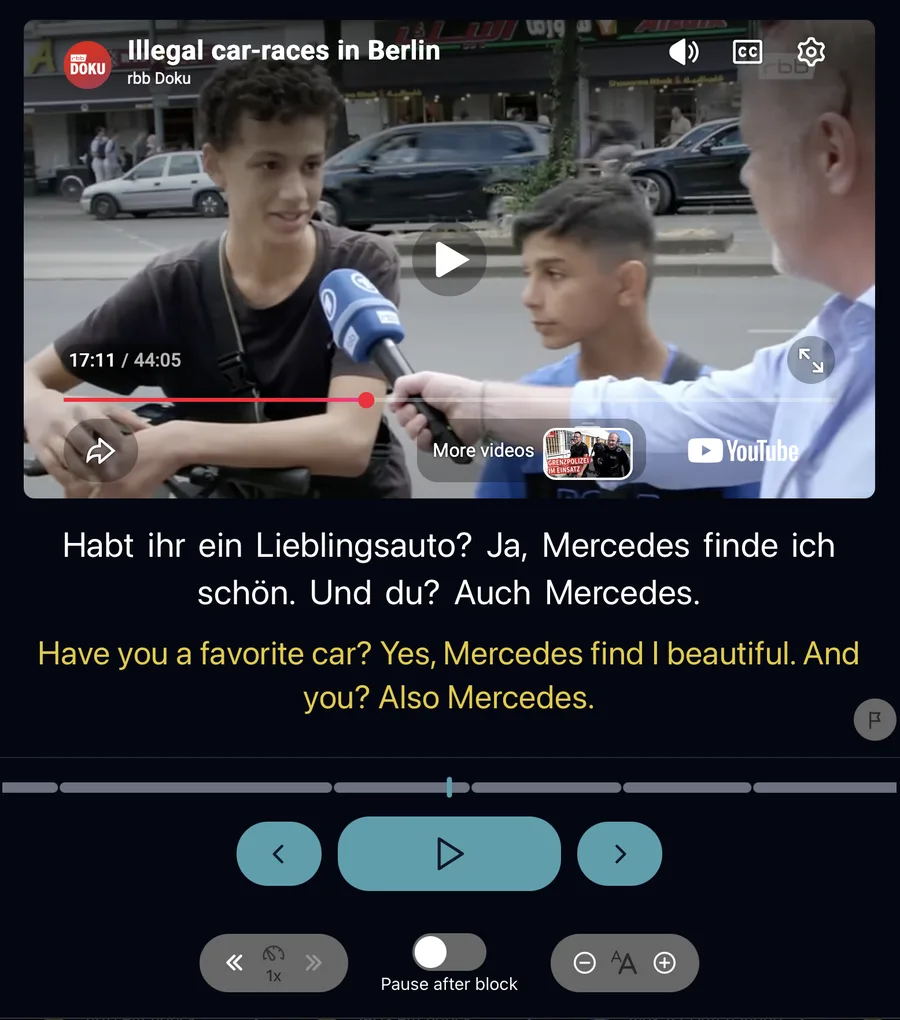
- Portuguese (Portugal) in white, the translation underneath in yellow
- Tap a word to see what it means
- Slow it down, or pause after each line
 47 minURGENTE: O Colapso do Irã que a Mídia EscondeViva Israel · 54k views
 100 minPaulo Figueiredo Show – Ep. 282 – O Que Disse Trump Sobre Condenação de Eduardo BolsonaroPaulo Figueiredo Show · 113k views
 15 minLULA NÃO ESPERAVA POR ISSO: TRUMP JÁ SABE DE TUDO!oiluiz TV · 408k views
 28 min#Ucrânia 2026-06-17: DRONES AUTÔNOMOS UCRANIANOS com AI eliminaram RUSSOS sem INTERFERÊNCIA HUMANAMundo em Revolução · 73k views
 24 minTESTEI SE A KAVIC É INTERESSEIRARenato Garcia · 1.39m views
 9 minComo o Irã derrubou um helicóptero de $35 milhões de dólares?Hoje no Mundo Militar · 206k views
13 more from June 2026
 94 minO É da Coisa de 18/06/2026, com Reinaldo Azevedo: PF e Wagner; Trump com Flávio, fuzilador moderadoRádio BandNews FM · 119k views
 87 minPOSSE DE BOLA COM MAURO CEZAR, TRAJANO, LAVIERI +: CAUTELA DE ANCELOTTI COM ENDRICK E 5º DIA DA COPAUOL Esporte · 180k views
 27 minENALDINHO VS YOUTUBERS – ESCONDE ESCONDE NO ESTÁDIO DE FUTEBOL | Super Copa do Enaldinho – Ep. 01Enaldinho · 1.97m views
 23 minTrancamos a Leticia e o Insa Na Prisão Até Eles Voltarem…Taspio · 920k views
 16 minA GRANDE DERROTA RUSSA I ProfessorProfessor HOC · 214k views
 25 minO QUE TEM DENTRO do APARELHO AUDITIVO?Manual do Mundo · 714k views
 14 minA DIARISTA QUE ENTROU SEM SABER NO ESQUEMA DO PCC – CASO DEOLANE BEZERRA – IC NEWSInvestigação Criminal · 637k views
 109 minNUNO MENDES & GONÇALO RAMOS | watch.tm 152Pedro Teixeira Da Mota · 357k views
 16 min"Cara, ME CONTARAM nos BASTIDORES que o RAPHINHA…" OLHA o que PROVOCOU DEBATE sobre a SELEÇÃO!Jovem Pan Esportes · 408k views
 18 minExclusivo: confira os depoimentos dos envolvidos na morte de Maria Eduarda durante salto radicalCidade Alerta · 518k views
 13 minO CASO DA MENINA QUE FOI ARREMESSADA ACABA DE FICAR PIOR!Não Adivinho · 348k views
 36 minVamos à BOLEIA de Portugal até ao Mundial – Ep.11Andamente · 52k views
 14 minComprei os Gadgets da Amazon com MAIS de 100.000 Avaliações (e funcionam mesmo)Nuno Agonia · 105k views
In the app, your first 30 minutes of listening are free. listening.lingophant.com is free in any browser.
Longer listening
Documentaries
Clear, well-edited Portuguese (Portugal), for when a short clip starts to feel easy.
TVI1.96m subscribers · 3 videos
É o canal de #televisão independente e generalista que junta os portugueses. Aqui vive o entretenimento, a ficção, a #informação. Aqui…


RTP698k subscribers · 5 videos
Rádio e Televisão de Portugal – Sempre Ligados. Por aqui partilhamos os melhores vídeos de programas nossos, de hoje, e de sempre.


5 more channels: Fala Portugal · SIC · RTP Notícias …
Fala Portugal76k subscribers · 4 videos
UM TELEJORNAL DIFERENTE, FEITO A PENSAR EM SI!
 10 minGrande Reportagem: Novo carro elétrico do técnico12k views
 9 minGrande Reportagem: Portugal, um paraíso criminal?6k views
 11 minGrande Reportagem: "Sementes que libertam"775 views
1 more from Fala Portugal

SIC 50k subscribers · 10 videos
Página oficial. A SIC mexe consigo!
 44 minDiogo Amaral: “O amor da Jéssica salvou-me montes de vezes”13k views
 48 minDiogo Batáguas: “Tudo o que faço é contraproducente para o meu bem-estar. Antes de entrar em palc…7k views
 47 minMiguel Guilherme sobre a leitura como forma de fugir à realidade2k views
7 more from SIC
 41 minNovo Podcast SIC | Pedalar Sem Idade Portugal: como uma ideia dinamarquesa ajuda a combater o iso…307 views
 59 minIrritações: Piolhos, lítio no Barroso, outdoors, sites de dopamina e trotinetes525 views
 44 minBonga: “Nós, africanos, celebramos tudo. Quando morrer, porque não celebrar? Cantem as minhas mús…88 views
 55 minNininho Vaz Maia em 2024: “Cresci a pensar que um dia ia para a prisão. Se aconteceu à minha volt…120 views
 53 min"Mais violento do que a prisão é a busca, a invasão, a violação de privacidade": Isaltino Morais …73 views
 43 minCarla Madeira, autora de ‘Tudo é Rio’, e a literatura como caminho para compreender a condição hu…395 views
 49 min“Senti-me completamente estilhaçada”: Beatriz Godinho fala pela primeira vez sobre a perda gestac…133 views
RTP Notícias6k subscribers · 10 videos
Todos. Pela verdade dos factos.
 46 minGrande Entrevista. Bruno Nogueira144k views
 51 minGrande Entrevista. Nuno Markl e o recurso ao humor na recuperação de dois AVC89k views
 51 minGrande Entrevista. Jorge Palma40k views
7 more from RTP Notícias
 46 minGrande Entrevista. Rita Blanco e Ruben Alves34k views
 14 minTemplo Romano de Beja. O passado mora aqui e vai poder ser visitado938 views
 33 minCrise na Habitação: Portugal vs. outros países europeus7k views
 51 minGrande Entrevista. Ricardo Mendes6k views
 10 min11 de setembro: foi assim que a RTP noticiou os atentados de Nova Iorque em 200179k views
 40 minBiografia do Brasil a caminho das eleições5k views
 53 minGrande Entrevista. Roberto Martínez4k views
TSF Rádio Notícias5k subscribers · 10 videos
𝗧𝘂𝗱𝗼 𝗼 𝗾𝘂𝗲 𝘀𝗲 𝗽𝗮𝘀𝘀𝗮, 𝗽𝗮𝘀𝘀𝗮 𝗻𝗮 𝗧𝗦𝗙
 62 minVisão de Jogo. "Rui Borges viu o jogo certo, Lage viu um jogo que ninguém viu!"16k views
 71 min"Martínez recuperou Ronaldo e Ronaldo segurou Martínez"11k views
 63 minVisão de Jogo – Como Rui Borges encontrou a fórmula que fez o Sporting campeão9k views
7 more from TSF Rádio Notícias
 170 minO debate decisivo foi na Rádio: reveja agora7k views
 131 minPresidenciais 2026: O Debate da Rádio5k views
 73 minDia de Reflexão: Acampados numa crise845 views
 43 minVisão de jogo – Sub-17 e Vitínha: O futebol português ainda é dos baixinhos5k views
 77 minDia de Reflexão: Fenómenos extremos no país ameno291 views
 77 minDia de Reflexão: O rei com ideias, o presidente com hérnias e o Bloco com fé381 views
 73 minDia de Reflexão: 5.484.869 votos e uma demissão558 views
História de Portugal JHS45k subscribers · 1 video
Documentários sobre a História de Portugal narrados pelo Prof. José Hermano Saraiva.

Grammar summaries
Noticing patterns?
You’ll notice these patterns while practising phrases. Each chapter is a short explanation and the best videos we found.
A1Ser vs. Estar (Two Verbs for 'To Be')
Portuguese has two verbs where English has one: 'ser' and 'estar', both meaning 'to be'. Ser is used for permanent or defining characteristics — identity, nationality, profession, and fixed descriptions (e.g., 'Eu sou português' — I am Portuguese; 'Ela é médica' — She is a doctor). Estar is used for temporary states, moods, locations, and conditions that can change (e.g., 'Estou cansado' — I am tired; 'O café está fechado' — The café is closed). In European Portuguese, estar is also the go-to verb for location even of permanent things, so 'Lisboa está em Portugal' is correct.
A reliable trick is to ask yourself: 'Could this change tomorrow?' If yes, use estar. If it defines who or what something fundamentally is, use ser. Learning a handful of fixed phrases from the app — like 'Estou bem' (I'm fine) and 'Sou de Inglaterra' (I'm from England) — will anchor both verbs in your memory through real context. Mastering this distinction lets you describe yourself, people around you, and situations accurately, which is essential for virtually every conversation you will ever have in Portuguese.
- Ser vs Estar: When to use which? [verb to be] // Quick Portuguese Lesson · Portuguese With Leo
- SER vs. ESTAR (verbs to be) in European Portuguese. What's the difference and how to use them? · karolinti
- SER vs ESTAR (to be) in Portuguese – Online Lecture · Mia Esmeriz Academy
A1Present Tense of Regular Verbs
Portuguese verbs are grouped into three families based on their infinitive endings: -ar (e.g., falar — to speak), -er (e.g., comer — to eat), and -ir (e.g., partir — to leave). Each family follows a predictable set of endings that you swap onto the verb stem. For -ar verbs: falo, falas, fala, falamos, falam. For -er verbs: como, comes, come, comemos, comem. For -ir verbs: parto, partes, parte, partimos, partem. Notice that European Portuguese often drops subject pronouns in speech because the verb ending already signals who is acting, so 'falo' alone means 'I speak'.
The best strategy is to pick one high-frequency verb from each family — falar, comer, and partir are ideal — and drill their full conjugation until it feels automatic. Once those three templates are solid, you can slot almost any new regular verb into the same pattern instantly. This unlocks your ability to talk about everyday actions in the present: what you eat, where you go, what you understand, and what you want — forming the backbone of real Portuguese conversation.
- Portuguese Verb Conjugation | How to conjugate verbs ending in AR [PRESENT TENSE] · Mia Esmeriz Academy
- How To Conjugate Portuguese Verbs Ending In -ER With Examples [PRESENT TENSE] · Mia Esmeriz Academy
- The Present of Regular Verbs · Simpleton Portuguese – Learn European Portuguese
A1Articles and Noun Gender (o/a, um/uma)
Every Portuguese noun has a grammatical gender — masculine or feminine — and articles must agree with it. The definite articles are 'o' (masculine singular), 'a' (feminine singular), 'os' (masculine plural), and 'as' (feminine plural). Indefinite articles are 'um', 'uma', 'uns', and 'umas'. Nouns ending in -o are usually masculine (o livro — the book) and those ending in -a are usually feminine (a mesa — the table), though there are common exceptions like 'o dia' (the day) and 'a mão' (the hand). Gender also ripples into adjectives, which must match the noun they describe.
Rather than trying to memorise gender rules abstractly, always learn a new noun together with its article — treat 'o livro' as one unit, not just 'livro'. The app phrases will naturally present nouns this way, so pay attention to the article every time. Getting articles right unlocks smooth, natural-sounding speech and ensures that adjectives, pronouns, and other words in a sentence all agree correctly — a fundamental building block for everything else in Portuguese grammar.
A2Preposition Contractions (em, de, a, por + articles)
In Portuguese, certain prepositions automatically merge with the articles that follow them, and these contractions are mandatory — you cannot skip them. The preposition 'em' (in/on) combines with 'o/a/os/as' to give 'no, na, nos, nas', and with 'um/uma' to give 'num, numa'. The preposition 'de' (of/from) combines to give 'do, da, dos, das' and 'dum, duma'. The preposition 'a' (to/at) combines with the definite articles to give 'ao, à, aos, às'. The preposition 'por' (by/through) contracts to 'pelo, pela, pelos, pelas'. For example, 'Venho de + o Porto' must become 'Venho do Porto'.
The trick is to stop thinking of these as separate words and instead memorise the contracted forms directly from natural phrases: 'no café', 'da cidade', 'ao mercado'. When you hear or read Portuguese, these contractions will appear constantly, and recognising them instantly prevents confusion about sentence structure. Once you internalise this pattern, you can accurately describe where things are, where you are coming from, and where you are going — core information exchanged in almost every practical interaction.
- Pela vs Pelo and other Prepositions in Portuguese · Mia Esmeriz Academy
- How to correctly use preposition -EM in European Portuguese. Grammar lesson for beginners · karolinti
- How to use the preposition a in Portuguese · Mia Esmeriz Academy
A2High-Frequency Irregular Verbs (ter, ir, fazer, poder, querer)
A small set of irregular verbs appears in almost every Portuguese sentence, and their forms must simply be learned directly because they do not follow the standard patterns. The most important are: ter (to have) — tenho, tens, tem, temos, têm; ir (to go) — vou, vais, vai, vamos, vão; fazer (to do/make) — faço, fazes, faz, fazemos, fazem; poder (can/to be able to) — posso, podes, pode, podemos, podem; querer (to want) — quero, queres, quer, queremos, querem. In European Portuguese, 'ir + infinitive' is also the main way to talk about near-future plans: 'Vou comer' means 'I'm going to eat'.
Because these verbs are so frequent, you will encounter them repeatedly in the app's phrases, which is actually the fastest route to memorisation — context does the heavy lifting. Focus first on the first-person singular (eu) forms, as these are what you need most to express your own intentions and abilities. Knowing these five verbs gives you enormous expressive power: you can say what you have, where you are going, what you are doing, what you can do, and what you want — essentially the core of everyday self-expression.
A2Simple Past Tense (Pretérito Perfeito)
The pretérito perfeito is the main tense for talking about completed actions in the past, equivalent to both 'I spoke' and 'I have spoken' in everyday European Portuguese speech. Regular -ar verbs take endings like -ei, -aste, -ou, -ámos, -aram (falei, falaste, falou, falámos, falaram). Regular -er verbs use -i, -este, -eu, -emos, -eram (comi, comeste, comeu, comemos, comeram). Several key verbs have irregular past forms that must be memorised: ser/ir both become fui, fui, foi, fomos, foram; ter becomes tive; fazer becomes fiz. Context usually clarifies any ambiguity between ser and ir.
A practical technique is to anchor the past tense to time expressions you already know: 'ontem' (yesterday), 'hoje de manhã' (this morning), 'na semana passada' (last week). Pairing a time word with a past verb form makes the tense feel natural and purposeful. Mastering the pretérito perfeito lets you recount events, tell stories, explain what happened, and talk about your experiences — skills that transform you from someone who can only talk about the present into a learner who can hold a real, meaningful conversation.
B1Direct and Indirect Object Pronouns
Portuguese uses short pronouns to replace nouns that have already been mentioned, keeping sentences fluid. Direct object pronouns answer 'what?' or 'whom?': me, te, o/a (him/her/it), nos, vos, os/as. Indirect object pronouns answer 'to whom?': me, te, lhe, nos, vos, lhes. A key feature of European Portuguese — one that distinguishes it sharply from Brazilian Portuguese — is that these pronouns are typically placed after the verb and joined by a hyphen in written form: 'Dá-me' (Give me), 'Vejo-o' (I see him). However, after negative words, question words, or conjunctions, the pronoun moves before the verb: 'Não o vejo' (I don't see him).
This pronoun placement rule is one of the areas where European Portuguese sounds most different from Brazilian Portuguese, so training your ear to this pattern early will help you sound natural in Portugal. A good learning strategy is to memorise complete phrases as chunks — 'Diz-me', 'Ajuda-me', 'Não te preocupes' — rather than trying to construct pronoun placement from rules alone. Once you control object pronouns, you can give and follow instructions, make requests, and discuss people and things without awkwardly repeating full nouns every time — a major step toward fluid, native-like speech.
- How to use direct object in European Portuguese- BASIC. Pronomes do complemento direto. · Listen and Learn Portuguese with Maria
- Direct and Indirect Object Pronouns · Portuguese Language Lessons
- Indirect Object Pronouns in Portuguese – Portuguese Tutorial | Portuguese with Eli · Portuguese with Eli
B1The Subjunctive Mood (Presente do Conjuntivo)
The subjunctive is a separate verb form used to express doubt, desire, emotion, possibility, or hypothetical situations — whenever the action is not presented as a straightforward fact. It is triggered by certain conjunctions and expressions: 'quero que' (I want that…), 'é importante que' (it's important that…), 'espero que' (I hope that…), 'quando' (when, referring to future events), 'se' (if, in open conditions), and 'para que' (so that). For regular verbs, you form the present subjunctive by taking the first-person singular present (eu) form, dropping the -o, and adding a new set of endings: for -ar verbs, use -e endings (fale, fales, fale…); for -er/-ir verbs, use -a endings (coma, comas, coma…).
The most practical entry point is to memorise a few high-frequency trigger phrases as fixed chunks — 'Espero que', 'É preciso que', 'Quando chegar' — and simply recognise that whatever verb follows will be in the subjunctive. You do not need to understand every nuance before you start using it. Gaining confidence with the subjunctive lets you express opinions, give advice, talk about future plans with conditions, and respond naturally to what others want or feel — moving your Portuguese from functional to genuinely expressive and idiomatic.
- How to use the SUBJUNCTIVE in Portuguese – Part 1/2 // Learn European Portuguese · Portuguese With Leo
- The 6 verb tenses of the SUBJUNCTIVE in Portuguese – Part 2/2 // Learn European Portuguese · Portuguese With Leo
- Speak Portuguese | How to Use Conjuntivo? Conjuntivo or Indicativo? 🇵🇹 · Learn Portuguese with Sofia
B2The Personal Infinitive (Infinitivo Pessoal)
The personal infinitive is a grammatical feature almost unique to Portuguese that does not exist in Spanish, French, or most other European languages. It is an infinitive form that can be inflected to agree with its subject, adding endings -es (tu), nothing (ele/ela), -mos (nós), -em (eles/elas) — while the eu form stays identical to the plain infinitive. It is used when the subject of an infinitive clause is different from the subject of the main verb, especially after prepositions: 'É importante vocês fazerem isso' (It is important for you to do that); 'Depois de eles chegarem, jantamos' (After they arrive, we will have dinner).
Many learners are initially confused by this form because nothing quite like it exists in their native language, but the pattern is actually very regular. Focus on recognising it after common prepositions — 'para', 'depois de', 'antes de', 'sem', 'ao' — and notice when the infinitive has an ending attached. Understanding the personal infinitive unlocks your ability to construct more complex, adult-sounding sentences where different people are doing different things, and helps you understand a large portion of written and spoken European Portuguese that would otherwise seem grammatically baffling.
- Como assim INFINITIVO PESSOAL? Quando se usa e como se forma · Susana Pereira – SP Academia
- When to use the Infinitivo Pessoal in European Portuguese. · Learn European Portuguese Online
- Infinitivo Pessoal versos Futuro do Conjuntivo · Susana Pereira – SP Academia