
Learn Portuguese (Brazil)

Olá como vai? Phrases to say and videos to understand, all free to start. Time on this page counts towards your streak.
DocumentariesGrammar in 9 chapters
Phrase sets
Say it without thinking
9 sets of everyday Portuguese (Brazil), with audio for every phrase. Add a set to the app and practise it there.
- Tap “Add phrases to app”Start with set 01.
- Tap Download in the appThe phrases land on your phone, with audio.New phraseset unlockedDownload all phrases to your phone?CancelDownload
- Practise 12 at a timeThe app tests you on 12 phrases at a time and schedules the next time you see each one.12phrases per batch,
spaced repetition
- Click “Check out phrases”The phraseset page opens. Listen to every phrase there.
- Scan the QR code with your phone’s cameraThe Lingophant app opens and asks to download the set. No app yet? The link takes you to the store first.
- Practise 12 at a timeThe app tests you on 12 phrases at a time and schedules the next time you see each one.
01 · Basic Phrases
14 phrases02 · Introductions
19 phrases03 · Useful Reactions
26 phrases6 more sets: Clarifications · Learning Languages · Interests, Opinions, Preferences …
04 · Clarifications
16 phrases05 · Learning Languages
20 phrases06 · Interests, Opinions, Preferences
24 phrases07 · Travel Phrases
20 phrases08 · Smalltalk
22 phrases09 · Politeness
8 phrasesWhere all 9 sets get you: 169 phrases
Your first 30 phrases are free, then 3 new phrases a day, or Premium for as many as you like. No account needed for your first two sets.
Popular on YouTube · May 2026
Watch with two subtitles
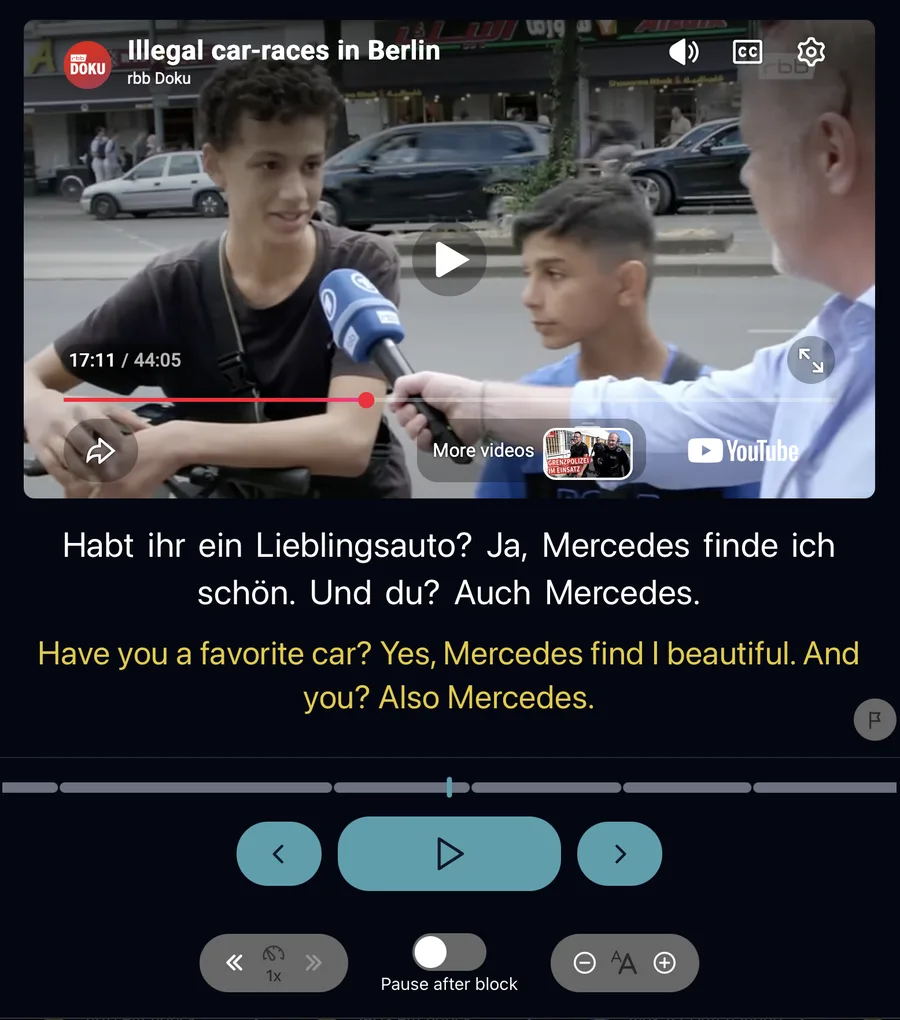
- Portuguese (Brazil) in white, the translation underneath in yellow
- Tap a word to see what it means
- Slow it down, or pause after each line
 16 minENVIEI MEU PLAYSTATION 5 PARA UM GOLPISTAMakarov · 422k views
 16 minA LEIA FURACÃO SAIU DA PRISÃO *Ela visitou a mansão dos Rosa !Leozinn 077 · 3.09m views
 25 minO QUE TEM DENTRO do APARELHO AUDITIVO?Manual do Mundo · 459k views
 19 minEP. 01 – 2/5: ESTREIA COM CULINÁRIA EUROPEIA E MATA-MATA | Temp. 13 | MASTERCHEF BRASILMasterChef Brasil · 816k views
 11 minExclusivo: veja o momento da prisão de Deolane Bezerra, suspeita de ligação com o PCCg1 · 1.22m views
 16 minESTADOS UNIDOS DESIGNA PCC e CV como ORGANIZAÇÕES TERRORISTAS INTERNACIONAISANCAPSU · 199k views
11 more from May 2026
 14 minTrump elogiou Lula na frente de Flávio Bolsonaro e falou sobre obra na Casa Branca | SanchesUOL · 366k views
 47 minA Bluey e o Bingo têm duas babás! 💙😯 | Bluey Português Brasil Canal OficialBluey Português Brasil – Canal Oficial · 478k views
 24 minBem-Vindos a Charmswell | Episódio Completo | Princesinha Sofia: Realeza MágicaDisney Jr. Brasil · 776k views
 11 minA Maior Virada Da História Da Tecnologia Aconteceu Ontem À Noite | Google I/OPaula Bernardes · 218k views
 47 minUCRÂNIA VIRA O JOGO NA GUERRA E AMEAÇA PODER DE PUTIN I Professor HOCProfessor HOC · 224k views
 20 minDEOLANE BEZERRA e seu SUPOSTO ENVOLVIMENTO com o PCC – FRANK EX-PCCCortes do Inteligência [OFICIAL] · 947k views
 10 minDEU TUDO CERTO! FLAMENGO SE DEU MUITO BEM! CONVERSAS INICIADAS PARA NOVA CONTRATAÇÃO! BOA NOTICIA! FLAZOEIRO · 204k views
 13 minSTF trama com governo Lula reação à notificação contra Moraes na Justiça dos EUARevista Oeste · 466k views
 11 minIMAGENS EXCLUSIVAS MOSTRAM TRAFICANTE SENDO OPERADO DENTRO DO COMPLEXO DA PENHARecord Rio · 376k views
 10 minMULHER É SALVA PELA POLÍCIA APÓS LIGAR 190 PEDINDO PIZZAPolícia Militar do Estado de São Paulo · 124k views
 96 minO É da Coisa de 28/05/2026, com Reinaldo Azevedo: 6 x 1 e reaças; EUA, PCC, CV: Flávio e intervençãoRádio BandNews FM · 154k views
In the app, your first 30 minutes of listening are free. listening.lingophant.com is free in any browser.
Longer listening
Documentaries
Clear, well-edited Portuguese (Brazil), for when a short clip starts to feel easy.
BBC News Brasil4.88m subscribers · 11 videos
Aqui você encontra o melhor da produção em vídeo da BBC News Brasil. Inscreva-se no nosso canal!
 55 minOs brasileiros que, sem saber, levaram 1 tonelada de cocaína dentro de barco | Documentário BBC2.98m views
 54 minKat Torres: a guru do Instagram condenada por tráfico humano e escravidão2.67m views
 25 minO abismo que separa as duas cidades com menor e maior IDH do Brasil2.16m views
8 more from BBC News Brasil
 20 minO que está por trás de cidade brasileira que viralizou por plásticas a preços imbatíveis1.26m views
 41 minDocumentário: BBC revela venda ilegal de terras na Amazônia pelo Facebook619k views
 30 minO Brasil do olhar estrangeiro: parte 4, Brasil chega a Hollywood528k views
 20 minO Brasil do olhar estrangeiro, parte 5: A ditadura e o Brasil dissonante417k views
 33 minComo pensam evangélicas, que podem definir eleição para presidente667k views
 23 min'O suicida vai para o inferno?': A crença que alimenta dor do luto por suicídio174k views
 28 minA incrível e dramática saga dos 33 mineiros do Chile | 21 notícias que marcaram o século 211.30m views
 35 minDocumentário BBC: O Golpista das Férias965k views
TV Brasil2.79m subscribers · 9 videos
Cultura, informação, prestação de serviço e esportes. Sou a sua TV Pública! 📺💙 #TVBrasil, um veículo EBC.
 28 minParque Nacional do Iguaçu | Parques do Brasil1.89m views
 30 minParque Nacional das Emas | Parques do Brasil1.40m views
 29 minParque Nacional do Itatiaia | Parques do Brasil1.27m views
6 more from TV Brasil
 29 minParques do Brasil – Unidades de conservação no sul da Bahia859k views
 24 minEspecial Folia de Reis na TV Brasil275k views
 26 minFortes do Brasil: Fortaleza de Santa Cruz da Barra (Niterói – RJ)70k views
 27 minCaminhos da Reportagem | Leishmaniose, retrato do abandono17k views
 25 minLuthiers apresenta os instrumentos de percussão11k views
 22 minFaróis do Brasil visita a Ilha de Cabo Frio14k views
10 more channels: DW Brasil · Estadão · Folha de S.Paulo …
DW Brasil1.24m subscribers · 10 videos
Jornalismo independente da Alemanha para o Brasil e o mundo.
 20 minO coração da imigração ilegal do Brasil para os EUA838k views
 26 minCidade brasileira tenta evitar seu destino infernal699k views
 26 minPor que tem tanta gente se mudando para Santa Catarina?190k views
7 more from DW Brasil
 26 minA guerra silenciosa contra as brasileiras | Documentário141k views
 23 minA guerra normalizada nas ruas brasileiras141k views
 21 minO setor em que o Rio é modelo na América Latina | Sou sua cidade160k views
 23 minPor que o Muro de Berlim foi erguido e por que caiu? | Podcast418k views
 28 minComo Milei mudou a Argentina | Documentário776k views
 27 minDocumentário | A batalha existencial de Portugal contra o avanço do mar3.76m views
 20 minO brasileiro pivô de denúncias de abusos em instituto recordista do Nobel206k views
Estadão1.32m subscribers · 12 videos
Canal de vídeos do jornal O Estado de S. Paulo.
 72 min#24 De ‘PUBLIS’ VELADAS ao ‘TIGRINHO’: como INFLUENCERS podem ser RESPONSABILIZADOS? | Dois Pontos345k views
 74 min#27 GERAÇÃO Z no mercado de TRABALHO: problemática ou consciente? | Dois Pontos295k views
 75 min#25 Quem deve resolver o problema da (IN)SEGURANÇA PÚBLICA no Brasil? | Dois Pontos279k views
9 more from Estadão
 71 min#26 O Brasil será um protagonista global na ERA DO CLIMA ou vai perder a oportunidade? | Dois Pontos238k views
 72 min#16 Ansiedade: o que é, como tratar e como prevenir? | Dois Pontos224k views
 85 min#21 Porte de drogas: o que pode acontecer com as discussões no STF e Congresso? | Dois Pontos187k views
 67 min#37 30 anos do Real: os bastidores do plano que venceu a hiperinflação no Brasil | Dois Pontos94k views
 68 minPor que a audiência das NOVELAS caiu tanto? | com SILVIO DE ABREU e MAURO ALENCAR | Dois Pontos #5266k views
 64 min#31 TRAGÉDIA CLIMÁTICA no RS: Como reconstruir o Estado e evitar novos desastres? | Dois Pontos2k views
 66 min#20 Obesidade: saúde pública, pressão estética e remédio para emagrecer | Dois Pontos180k views
 76 min#29 Como a ÁSIA reduziu a POBREZA e o que o BRASIL pode aprender com isso? | Dois Pontos295k views
 72 min#23 Por que falhas no ensino de ciências exatas podem levar a apagão de profissionais? | Dois Pontos182k views
Folha de S.Paulo1.09m subscribers · 5 videos
Entrevistas, documentários, análises e reportagens produzidos pela Folha


Brasil de Fato853k subscribers · 4 videos
Uma visão popular do Brasil e do mundo.




Repórter Brasil21k subscribers · 1 video
Denunciamos violações de direitos humanos, investigamos cadeias produtivas de grandes setores e atuamos na prevenção do trabalho escravo

Opera Mundi495k subscribers · 8 videos
Análise crítica, conteúdo global e o compromisso histórico com as causas populares
 62 minMiguel Nicolelis explica a Geopolítica da Ciência | Disputa Tecnológica EUA x China – 20 Minutos202k views
 94 minUma nova crise mundial está a vista? – José Kobori – Programa 20 Minutos186k views
 52 minVladimir Safatle – Por que o fascismo nos espera? – programa 20 Minutos92k views
5 more from Opera Mundi
 98 minJones Manoel – Segunda Guerra: o ocidente MENTE contra a União Soviética – programa 20 Minutos92k views
 26 min20 Minutos História – Como a guerra civil forjou os EUA?12k views
 58 minTudo sobre a fraude das criptomoedas de Milei e a crise política argentina – Mario Santucho15k views
 77 minMônica Valente: Para onde vai o Foro de São Paulo?3k views
 23 minAula Pública Opera Mundi com Haroldo Ceravolo – Livros, bibliodiversidade e democracia707 views
VEJA+1.22m subscribers · 13 videos
VEJA: Saiba antes. Saiba mais.
 26 minDocumentário Caso Henry Borel: A Marca da Maldade – Sonho, Decepção e Tragédia (Episódio 1)182k views
 37 minPlantar florestas pode movimentar até US$ 26 bi por ano – Fabio Sakamoto, da Biomas | VEJA+ Verde154k views
 29 minPJ vai virar regra no Brasil? Entenda o que está em jogo30k views
10 more from VEJA+
 34 minFim da escala 6×1 avança: o que isso pode mudar na sua vida? | Mercado10k views
 44 minEleição 2026: o que explica a ascensão de Flávio Bolsonaro? | Ponto de Vista79k views
 22 minInfluencer evangélica Isabelle Ramos fala sobre sexo e religião | VEJA e Viva2k views
 55 minCorinthians atropela favoritismo, é campeão e ofusca Paquetá | Bola Quadrada2k views
 25 minComo Sylvinho virou herói nacional na Albânia e pode ser o único treinador brasileiro na Copa681 views
 54 minEntrevista com Carlos Fávaro, ministro da Agricultura e Pecuária | Em Pauta1k views
 23 minPapel do agro brasileiro na transição energética global | VEJA Fórum Agro822 views
 51 minEntrevista com Luísa Sonza | Em pauta3k views
 22 minDesenrola 2.0 ajuda agora, mas pode piorar depois? | Mercado1k views
 59 minPainel: Emendas parlamentares, uma história de captura do orçamento público do Brasil após 2014982 views
SBT News7.91m subscribers · 2 videos
O FATO COMO ELE É.


Diogo Elzinga732k subscribers · 13 videos
Elzinga é um curioso jornalista e explorador que busca apenas aquele "extra" do mundo ordinário que pensamos conhecer. Não espere encontrar…
 37 minA CIDADE SUBTERRÂNEA | Ametista do Sul [DOCUMENTÁRIO]1.87m views
 22 minO Estereótipo de Cada Estado Brasileiro927k views
 25 minTalian, o IDIOMA PROIBIDO do Brasil [DOCUMENTÁRIO]232k views
10 more from Diogo Elzinga
 37 minA ITÁLIA BRASILEIRA | Antônio Prado [DOCUMENTÁRIO]595k views
 39 minA Vida na CIDADE MAIS FRIA do Brasil | Urupema [DOCUMENTÁRIO]798k views
 50 minA PÉROLA do LITORAL de SC | Laguna [DOCUMENTÁRIO]177k views
 23 minPor que o PARÁ é o MELHOR ESTADO do Brasil?262k views
 26 minO significado da BANDEIRA de CADA ESTADO brasileiro529k views
 27 minA pequena CIDADE GAÚCHA que criou um SUPERCARRO DE LUXO | Casca [DOCUMENTÁRIO]244k views
 49 minA ALEMANHA e o JAPÃO do RS | Ivoti [DOCUMENTÁRIO]371k views
 66 minA CIDADE GAÚCHA que a UNESCO RECONHECEU | Caçapava do Sul [DOCUMENTÁRIO]565k views
 42 minVeranópolis SABE O SEGREDO DA LONGEVIDADE | Veranópolis [DOCUMENTÁRIO]149k views
 35 minA cidade MAIS ALTA E FRIA do RS | São José dos Ausentes [DOCUMENTÁRIO]1.52m views
ABC Terra619k subscribers · 10 videos
História da natureza e a natureza da história.
 42 minComo era o mundo 200 mil anos atrás?7.16m views
 43 minComo era o Brasil na era dos dinossauros?3.14m views
 56 minA evolução dos humanos: Quando nós não estávamos sozinhos.2.35m views
7 more from ABC Terra
 79 minComo a era do gelo moldou a humanidade?1.52m views
 31 minA vida do Giganotosaurus1.20m views
 43 minA história dos cães e gatos: quem domesticou quem?640k views
 35 minQuando répteis voavam pelo Brasil196k views
 39 minDepois de nós: A zoologia do futuro.1.00m views
 34 minComo desextinguir os mamutes pode resfriar o planeta?626k views
 40 minComo a ciência decifrou as cores REAIS desses 5 animais extintos?435k views
Grammar summaries
Noticing patterns?
You’ll notice these patterns while practising phrases. Each chapter is a short explanation and the best videos we found.
A1Ser vs. Estar (Two Ways to Say 'To Be')
Brazilian Portuguese has two verbs that both translate as 'to be' in English: ser and estar. Ser is used for permanent or defining characteristics — identity, nationality, profession, and inherent traits (e.g., 'Eu sou brasileiro' — I am Brazilian; 'Ela é médica' — She is a doctor). Estar is used for temporary states, moods, locations, and conditions that can change (e.g., 'Estou cansado' — I am tired; 'Ele está em casa' — He is at home). Some situations can use either verb with a shift in meaning: 'Ele é nervoso' means he is a nervous person by nature, while 'Ele está nervoso' means he is nervous right now.
A reliable trick is to ask yourself: 'Would this still be true in a year?' If yes, lean toward ser; if it could easily change, use estar. Pay attention to how native speakers use these verbs in the phrases you study on the app — you will start to feel the pattern intuitively. Once you master this distinction, you can describe people, places, and situations accurately, express how you and others feel, and avoid one of the most common mistakes learners make in Portuguese.
- Speaking Brazilian – The Differences Between Ser & Estar · Speaking Brazilian Language School
- Ser vs Estar: When to use which? [verb to be] // Quick Portuguese Lesson · Portuguese With Leo
- Learn the Difference Between SER and ESTAR (verb to be) in Brazilian Portuguese! · Plain Portuguese
A1Present Tense of Regular Verbs
Portuguese verbs are grouped into three conjugation families based on their infinitive endings: -ar (falar — to speak), -er (comer — to eat), and -ir (partir — to leave). In the present tense, each group follows a predictable set of endings attached to the verb stem. For -ar verbs: eu falo, você fala, nós falamos, eles falam. For -er verbs: eu como, você come, nós comemos, eles comem. For -ir verbs: eu parto, você parte, nós partimos, eles partem. In Brazilian Portuguese, você (you singular) and ele/ela (he/she) share the same conjugation form, which cuts your memorisation in half for those forms.
Rather than drilling conjugation tables in isolation, practise each verb inside a real sentence you actually want to say. Chunking phrases like 'Eu trabalho aqui' or 'Ela come muito' builds automatic recall far faster than abstract lists. Once you internalise these patterns, you can talk about daily routines, habits, and present actions — the backbone of almost every everyday conversation.
- How to conjugate regular verbs in Portuguese – part 1 · Speaking Brazilian Language School
- How to Conjugate Regular -AR Ending Verbs in Brazilian Portuguese – Present Tense #plainportuguese · Plain Portuguese
- Understanding Verb Conjugation Once and for All + Present Tense of Regular Verbs – Portuguese lesson · Street Smart Brazil
A1Noun Gender and Definite/Indefinite Articles
Every noun in Portuguese is either masculine or feminine, and this gender determines which article you use. The definite articles are o (masculine singular), a (feminine singular), os (masculine plural), and as (feminine plural) — equivalent to 'the' in English. The indefinite articles are um, uma, uns, umas — equivalent to 'a/an' or 'some'. Most nouns ending in -o are masculine (o livro — the book) and most ending in -a are feminine (a mesa — the table), though there are exceptions worth noting, like o dia (the day) and o mapa (the map). Adjectives must also match the gender of the noun they describe, so getting gender right unlocks agreement across the whole sentence.
When you learn a new noun on the app, always learn it together with its article as one chunk — 'o carro' not just 'carro'. This way, gender is stored as part of the word's identity rather than a separate fact to recall. Once you have this foundation, you can correctly describe and refer to objects, people, and places using articles and matching adjectives, making your sentences sound natural and grammatically coherent.
- When to Use O, A, OS, AS (The Definite Article Rule) · Plain Portuguese
- Learn Masculine and Feminine Nouns in Brazilian Portuguese Quickly · Plain Portuguese
- Portuguese Online 10- Nouns and Articles · Portuguese Online
A1Talking About the Future with 'Ir' (Going To)
The most natural way Brazilians talk about future plans and intentions is not with the formal future tense but with the present tense of ir (to go) followed by an infinitive — exactly like 'going to' in English. The formula is: subject + ir (conjugated) + infinitive verb. For example: 'Eu vou viajar amanhã' (I'm going to travel tomorrow), 'Ela vai comprar um carro' (She's going to buy a car), 'Nós vamos comer juntos' (We're going to eat together). The conjugations of ir in the present are: eu vou, você/ele/ela vai, nós vamos, vocês/eles vão. This structure is used constantly in both casual speech and informal writing.
Because ir is irregular and very high-frequency, it is worth memorising its present tense forms as a fixed list right away. Then combine it with infinitives you already know to generate unlimited future sentences. Once you master this construction, you can talk about weekend plans, near-future intentions, and make and respond to invitations — all essential skills for real-life conversation from very early on.
A1High-Frequency Irregular Verbs (Ter, Ir, Fazer, Querer, Poder)
A small set of irregular verbs appears in almost every conversation in Brazilian Portuguese. The most important are: ter (to have) — eu tenho, você tem, nós temos, eles têm; ir (to go) — eu vou, você vai, nós vamos, eles vão; fazer (to do/make) — eu faço, você faz, nós fazemos, eles fazem; querer (to want) — eu quero, você quer, nós queremos, eles querem; poder (to be able to/can) — eu posso, você pode, nós podemos, eles podem. These verbs appear so often that even a partial mismatch sounds jarring to native speakers, so accuracy here pays off enormously.
Because these verbs are irregular, spaced repetition through the app's phrases is the most efficient way to lock them in — seeing 'Eu tenho fome' and 'Você tem razão' repeatedly in context beats memorising paradigms cold. Once these verbs are automatic, you can express possession, ability, desire, and action — the core building blocks of almost any message you want to communicate in Portuguese.
A2Essential Contractions with Prepositions (de, em, a + articles)
Portuguese automatically contracts certain prepositions with articles, and these contractions are mandatory — skipping them sounds unnatural. The preposition de (of/from) combines with definite articles to form do, da, dos, das (e.g., 'a cor do carro' — the colour of the car) and with indefinite articles to form dum, duma. The preposition em (in/on/at) contracts to no, na, nos, nas with definite articles (e.g., 'Estou no trabalho' — I'm at work). The preposition a (to/at) merges with the feminine definite article to form à (e.g., 'Vou à praia' — I'm going to the beach), though in practice Brazilians often drop this contraction in casual speech. These forms appear in virtually every sentence that mentions location, origin, or possession.
The best approach is to absorb these as fixed chunks: always say 'no Brasil', 'da minha família', 'à noite' rather than trying to build them from rules each time. Look out for them in every phrase you practise on the app. Once you internalise these contractions, your speech will flow naturally and you will understand spoken Portuguese far more easily, since native speakers use contracted forms constantly without pause.
- How to Use DE, DO, DA in Brazilian Portuguese – The Preposition DE in Portuguese · Plain Portuguese
- Word Contractions in Brazilian Portuguese · Speaking Brazilian Language School
- How to Use EM, NO, NA in Brazilian Portuguese – The Preposition EM in Portuguese · Plain Portuguese
A2Simple Past Tense (Pretérito Perfeito)
The pretérito perfeito is the main past tense for completed actions in Brazilian Portuguese, equivalent to both the English simple past ('I spoke') and present perfect ('I have spoken'). Regular -ar verbs take endings like: eu falei, você falou, nós falamos, eles falaram. Regular -er/-ir verbs follow: eu comi/parti, você comeu/partiu, nós comemos/partimos, eles comeram/partiram. Key irregular past forms to prioritise are: fui (I went / I was — from both ir and ser), tive (I had), fiz (I did/made), vim (I came), and disse (I said). These irregular forms are extremely common in storytelling and daily recounting.
Start by mastering the você/ele/ela past forms alongside eu, since those two cover the vast majority of conversational scenarios. Notice that in the past tense, ser and ir share the same forms (fui, foi, fomos, foram), so context tells you which meaning applies. Once you control this tense, you can recount events, share experiences, ask what happened, and understand stories — skills that are indispensable for real relationships and genuine conversation.
- 30 Key Verbs in the Past Tense | Brazilian Portuguese · Speaking Brazilian Language School
- Pretérito Perfeito vs Pretérito Imperfeito in Brazilian Portuguese – Everything you need to know! · Speaking Brazilian Language School
- O passado em português | Pretérito perfeito e pretérito imperfeito | Vou Aprender Português · Vou Aprender Português
A2Direct Object Pronouns (me, te, o/a, nos)
Object pronouns replace nouns that have already been mentioned, making speech flow naturally. In Brazilian Portuguese, the most practical object pronouns are: me (me), te (you, informal), nos (us), and the third-person forms o/a (him/her/it). In formal written Portuguese these pronouns attach to verbs with hyphens (fala-me), but in everyday Brazilian speech they almost always appear before the verb: 'Ele me ligou' (He called me), 'Eu te amo' (I love you), 'Pode me ajudar?' (Can you help me?). Importantly, Brazilians very commonly replace o/a with ele/ela or even drop the object entirely in casual speech: 'Você viu?' instead of 'Você o viu?' — so don't stress about third-person object pronouns at first.
Focus first on me and te since they are the highest-frequency forms in real conversation and appear in countless everyday phrases like 'Me dá', 'Me fala', and 'Me liga'. Once you recognise and use these pronouns naturally, you can have fluid back-and-forth exchanges, understand who is doing what to whom in conversations, and respond to requests and offers without awkward repetition of full noun phrases.
- How to Use Object Pronouns in Brazilian Portuguese (part I) · Plain Portuguese
- How to Use Object Pronouns in Brazilian Portuguese (part II) | When to Use LO, LA, LOS, LAS · Plain Portuguese
B1Present Subjunctive with Common Triggers
The subjunctive mood expresses doubt, desire, emotion, recommendation, or uncertainty — and in Brazilian Portuguese it is triggered by specific phrases followed by 'que'. The most conversationally important triggers include: quero que (I want that/you to), espero que (I hope that), é importante que (it's important that), tomara que (hopefully), and talvez (maybe/perhaps). After these triggers, the verb changes form: for -ar verbs, the endings become -e (fale, compre); for -er/-ir verbs, they become -a (coma, abra). For example: 'Espero que você venha' (I hope you come), 'Quero que ele fale a verdade' (I want him to tell the truth), 'Talvez ela saiba' (Maybe she knows).
Rather than memorising the full subjunctive paradigm upfront, learn the triggers as fixed launching pads — 'espero que + subjunctive verb' as one unit. When you see these trigger phrases in the app, pay attention to the verb form that follows and you will internalise the pattern naturally over time. Once you have a working grasp of the subjunctive, you can express wishes, give nuanced opinions, talk about possibilities, and understand a huge range of natural Brazilian speech that would otherwise seem grammatically puzzling.
- The Subjunctive in Portuguese – Verb Tenses Explained · Speaking Brazilian Language School
- 30 Verbs in the Present Subjunctive – Conjugation Drill | Brazilian Portuguese · Speaking Brazilian Language School
- The Present Subjunctive in Brazilian Portuguese | One of the Uses of The Subjunctive in Portuguese · Plain Portuguese