
Learn Hungarian

Szia, hogy vagy? Phrases to say and videos to understand, all free to start. Time on this page counts towards your streak.
DocumentariesGrammar in 9 chapters
Phrase sets
Say it without thinking
9 sets of everyday Hungarian, with audio for every phrase. Add a set to the app and practise it there.
- Tap “Add phrases to app”Start with set 01.
- Tap Download in the appThe phrases land on your phone, with audio.New phraseset unlockedDownload all phrases to your phone?CancelDownload
- Practise 12 at a timeThe app tests you on 12 phrases at a time and schedules the next time you see each one.12phrases per batch,
spaced repetition
- Click “Check out phrases”The phraseset page opens. Listen to every phrase there.
- Scan the QR code with your phone’s cameraThe Lingophant app opens and asks to download the set. No app yet? The link takes you to the store first.
- Practise 12 at a timeThe app tests you on 12 phrases at a time and schedules the next time you see each one.
01 · Basic Phrases
15 phrases02 · Introductions
17 phrases03 · Useful Reactions
26 phrases6 more sets: Clarifications · Learning Languages · Interests, Opinions, Preferences …
04 · Clarifications
18 phrases05 · Learning Languages
20 phrases06 · Interests, Opinions, Preferences
24 phrases07 · Travel Phrases
21 phrases08 · Smalltalk
22 phrases09 · Politeness
7 phrasesWhere all 9 sets get you: 170 phrases
Your first 30 phrases are free, then 3 new phrases a day, or Premium for as many as you like. No account needed for your first two sets.
Popular on YouTube · May 2026
Watch with two subtitles
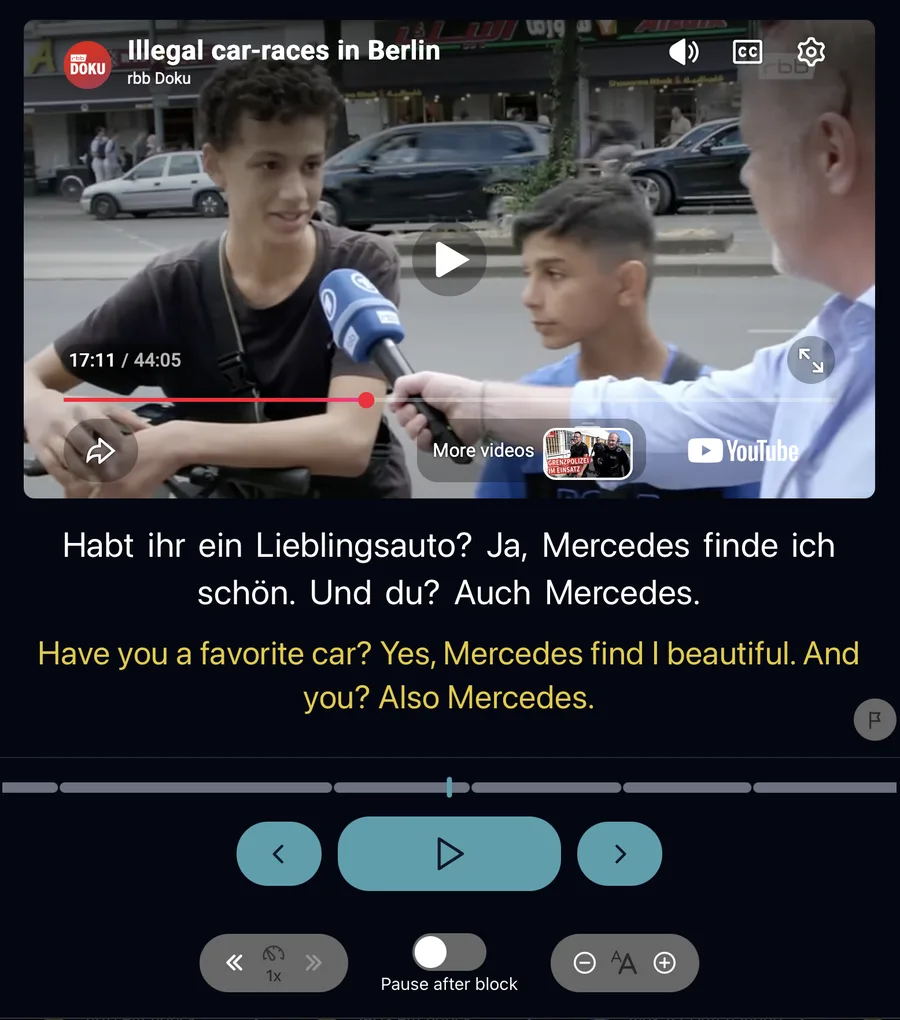
- Hungarian in white, the translation underneath in yellow
- Tap a word to see what it means
- Slow it down, or pause after each line
 29 minAZ EU AZ OROSZ CIVILEKET BÜNTETI / KIMENŐ A MERÉNYLŐNEK / A NAGYON DRÁGA NORVÉG WC-BEZÁRÁS | NYÚZThuróczy Richard · 31k views
 25 minMc Torockai – HIGH TECH, luxus PROJEKTOR | Luxizik a TISZA?!OliverWhiteOfficial · 22k views
 12 minNESSAJ MEME REAKCIÓ #21 🔥Nessaj · 136k views
 36 minVISSZAFOGLALTUK a jászsági telket! 🏠 🌳(Bűnvadászok 46.)BŰNVADÁSZOK · 388k views
 18 min🚨 MAGYAR PÉTER SZÉP GESZTUST TETT! 🚨/ DIPLOMATA ÚTLEVÉL BOTRÁNY!😱/ SULYOK VERGŐDIK!😂Mi ez az ország?! · 31k views
 22 minNyitottam Egy Kamu McDonald's Éttermet a Házamban!Alex Csigér · 478k views
14 more from May 2026
 12 minBrendon 13 éves, tehát betörhetBecsületesnepper · 76k views
 31 minVonaton és repülőn követtük végig Magyar Pétert első külföldi útjánTelex․hu · 258k views
 17 minA Mandalorian filmnek nem szabadott volna megtörténnie…HollywoodNewsAgency · 42k views
 29 minÚJ FRIZURA vagy YouTuber PANKRÁCIÓ? ✂️ – TikToklesen #14 | 2026. ÁprilisJustVidman2 · 48k views
 46 minNA IDE beköltöznénk! 🤯TheVR Podcast · 74k views
 20 minFerrari Luce: mit tud fél millió euróért egy elektromos autó?Andras Horvath · 110k views
 25 minAz elmúlt 20 év ÖSSZES BL döntő gólja egy videóban! 🏆Nessaj FC · 100k views
 66 minVAKRANDI: RRGERI VS 6 LÁNYRodrigó Rapport · 179k views
 16 min🌠 FRISS: Felrobbant a New Glenn rakéta a statikus teszten! | KisOkos #120 | ŰRKUTATÁS MAGYARULŰrkutatás magyarul · 27k views
 33 minILYEN BELÜLRŐL a világ egyik LEGIKONIKUSABB hotele – VIP vendégkéntA Vendég · 71k views
 68 minUtolsó helyen végeztem. – VERSENY NAPI VLOGODETT · 94k views
 42 minA James Webb űrtávcső – Áttörés az űrkutatásban! [TELJES FILM]National Geographic Magyarország · 106k views
 10 minHadházi László – Lopásgátló strandtörölköző | Showder Klub Best ofShowder Klub Official · 70k views
 10 minSzezon helyett katasztrófa készül a Velencei-tónálNépszava · 67k views
In the app, your first 30 minutes of listening are free. listening.lingophant.com is free in any browser.
Longer listening
Documentaries
Clear, well-edited Hungarian, for when a short clip starts to feel easy.
Partizán695k subscribers · 5 videos
Írj nekünk!
 103 minEXKLUZÍV: Varga Judit exférje a pedofilbotrányról, Rogán Antalról és a fideszes törésvonalakról3.03m views
 49 minSZENNYHULLÁM #1 | Magyar punkmozaik '78-84 | PartizánDOKU106k views
 52 min“Magyarként nem a svájci hegyek között halnék meg” I Karsai Dániel-interjú az életvégi döntésekről154k views


Telex․hu449k subscribers · 5 videos
Ez a Telex.hu internetes újság videócsatornája, ahol híreket, elemzéseket, portrékat, riportokat, emberkísérleteket találsz komoly vagy épp…



9 more channels: 444.hu · Direkt36 · Szabad Európa …
444.hu394k subscribers · 2 videos


Direkt36105k subscribers · 4 videos
Ez a Direkt36 Youtube-csatornája, itt található meg minden videós tartalmunk.
 56 minA dinasztia (The Dynasty) – így született az Orbán család gazdasági birodalma4.32m views
 99 min"Egy ideális rendszerben nem kellene itt ülnöm" – megszólal a nyomozó a Tisza-műveletről2.90m views
 98 minA CSAPDA (THE TRAP) – Az Orbán-korszak elvesztett lehetőségeinek története1.58m views
1 more from Direkt36

Szabad Európa79k subscribers · 12 videos
Ez a Szabad Európa YouTube csatornája, ahol politikai és gazdasági befolyástól független, objektív és hiteles videókat kínálunk. Lejátszási…
 24 minKisajátítva – Az elbitorolt mórahalmi 6-os körzet földjei481k views
 22 minA cigánymentes falu – "Nem azért végeztem jogot, hogy egy polgármester mondja meg, hova költözhetek"433k views
 34 minA Balaton túl van a tűrőképessége határán231k views
9 more from Szabad Európa
 25 minMegállíthatatlanul ömlik a szemét a Tiszába145k views
 21 min„A karácsony a legszörnyűbb ünnep a gyermekotthonokban”78k views
 20 min"Hello.Tourist!" – a legénybúcsúsoktól a Louis Vuitton vásárlókig28k views
 28 minHúsz éve az EU-ban – A kihagyott lehetőség31k views
 30 minSzabadon – Az akkugyárak árnyékában51k views
 20 minKína Magyarországon – a nagy befektető25k views
 25 minGyarmathy Éva: A vizsgált elsősök 20 százaléka nem felel meg az iskolarendszer elvárásainak135k views
 23 minA templom már a zaciban – Az eladósodott MET Egyház és a kormány csatája60k views
 30 minRákosrendezőből Rákos-Dubaj? – ezer milliárdokból kifényesített rozsdaövezet74k views
ATV Magyarország503k subscribers · 12 videos
Az ATV az első magántelevízió hazánkban. A minőségi, színvonalas, magas értékrendű műsorok készítését és sugárzását célul kitűző…
 76 min40 éve történt a csernobili atomkatasztrófa85k views
 46 minHúzós podcast / Zacher Gábor – Állandóan szorongunk113k views
 20 minPogátsa Zoltán: A Fidesz sem tudná tovább csinálni azt, amit eddig csinált, az a modell kifulladt332k views
9 more from ATV Magyarország
 26 min„Megjósolhatatlan, mi fog történni” – drámai interjút adott a MOL-vezér az Egyenes Beszédben70k views
 24 min🔴 Botrányos kifizetések az NKA-nál: Rónai Egon megizzasztotta a minisztert320k views
 24 minBródy János visszavonul – Rónai Egonnál tett bejelentést a zenész61k views
 59 minToroczkai: Benne van a pakliban, hogy a politikust lelövik | MÉRLEG Rónai Egonnal140k views
 41 minCsernus Imre: A választási siker nem végpont, hanem a kezdet | KONKRÉTAN Rónai Egonnal92k views
 74 minOrbán Viktor Magyarról, Wábererről és a lehallgatásokról | MÉRLEG196k views
 49 min🎯 KARAKTERGYILKOSSÁGOK – Juhász, Gyurcsány, Orbán és Semjén a célkeresztben | CSATT 2025.10.06.68k views
 25 minSzijjártó Péter JD Vance látogatásáról, a csádi misszióról, Szergej Lavrovról és a gázvezeték-ügyről56k views
 48 minVona Gábor: „Orbán nem egy szimpla pártelnöke a Fidesznek, hanem a sámánja” | CSATT 2026.04.27.70k views
Hír TV286k subscribers · 2 videos
A Hír TV elsődleges feladatának tekinti, hogy a nézők számára hiteles és jól befogadható módon tegye lehetővé azt a széleskörű…


Atlatszo60k subscribers · 4 videos
Cikkeink


M5114k subscribers · 15 videos
Az M5 a közmédia kulturális csatornája.
 40 minHorthy és Hitler találkozói – M5 História107k views
 40 minA honfoglalók előtti évszázadok: Az avarok története – M5 História87k views
 40 minA Tanácsköztársaság rémtettei – M5 História41k views
12 more from M5
 25 minÉrettségi 2017 – Történelem: Szent István államszervező tevékenysége40k views
 26 minÉrettségi 2017 – Magyar: Madách Imre: Az ember tragédiája27k views
 40 minBetyárok, a magyar banditák – M5 História22k views
 26 minLáng Orsolya: Magyar pompeji – az aquincumi polgárváros története (Mindenki Akadémiája)12k views
 25 minFekete Ildikó: Magyar hímes tojások (Mindenki Akadémiája)12k views
 39 minHuszárhagyományok – M5 História11k views
 40 minBáthory 450 – Erdélytől a lengyel trónig – M5 História10k views
 39 minVajdasági sorsok – M5 História14k views
 39 minKádárék bosszúja – Hogyan törték meg ’56 hőseit? – M5 História13k views
 40 min180 éves a magyar vasút – M5 História13k views
 40 minA Trianonhoz vezető békék – M5 História12k views
 26 minSimonyi Balázs: A futás mint tevékenység, filozófia és motiváló erő a mindenna (Mindenki Akadémiája)36k views
Mandiner144k subscribers · 7 videos
Mandiner – A Nemzeti Álláspont
 27 minOrbán nem oroszbarát, Amerikát átvették az őrültek – Tucker Carlson Budapesten12k views
 22 min„Ha nem tudod megvédeni a határaidat, elveszted az országod” – Interjú Benjamin Netanjahuval8k views
 46 minGrammy-díjas zenész: Úgy kezelik a konzervatívokat, mint Brüsszel Magyarországot | MAXIMA2k views
4 more from Mandiner
 53 minSajtóvadászat | A Magyar Péter-hatás: agresszió, fenyegetés, zaklatás34k views
 30 minA propaganda hatása és a nők szerepe a Közel-Keleten – Gulyás Virág interjúja Hayvi Bouzoval!2k views
 44 minSzabályok vagy ideológia? A sport tisztasága a tét | Sebastian Coe a MAXIMÁBAN1k views
 28 minFordulat: konzervatív elnöke lesz Lengyelországnak! – Rosonczy-Kovács Mihály és Jacek Karnowski20k views
Ljasuk Dimitry43k subscribers · 1 video
Azért kezdtem el filmezni, hogy újra összehozzam az embert a természettel és mepróbáljam átadni az élet szeretetét.

Grammar summaries
Noticing patterns?
You’ll notice these patterns while practising phrases. Each chapter is a short explanation and the best videos we found.
A1Vowel Harmony
Vowel harmony is the single most important pattern in Hungarian: every suffix you attach to a word must use vowels that match the vowels in the root word. Words containing front vowels (e, é, i, í, ö, ő, ü, ű) take front-vowel suffixes, while words with back vowels (a, á, o, ó, u, ú) take back-vowel suffixes. For example, the suffix meaning 'in' is -ban after back-vowel words (házban – in the house) but -ben after front-vowel words (kertben – in the garden). Almost every suffix in Hungarian has two or three vowel-harmony variants.
The best way to internalise this is to learn each new word together with a sample suffix — treat 'ház → házban' as a single chunk rather than memorising the rule abstractly. When you encounter a new word in the app, notice whether its main vowel feels 'back' (open, rounded: a, o, u) or 'front' (brighter: e, i, ö, ü) and predict which suffix form fits. Once this clicks, you will correctly inflect nouns, attach verb endings, and form postpositional phrases automatically, which means nearly every sentence you produce will sound natural rather than jarring.
- 🇭🇺 VOWEL HARMONY – magánhangzó harmónia | Hungarian for beginners · Hungarian with Sziszi
- Hungarian Vowel Harmony – Learn Hungarian with Oliver! · Learn Hungarian with Oliver!
- Hungarian grammar for beginners: Vowel harmony (hangrend) · Speak Hungarian with Angie
A1Core Noun Cases (Accusative, Dative & Key Locatives)
Hungarian uses suffixes called cases instead of prepositions to show a noun's role in a sentence. The most essential ones for early conversation are: the accusative (-t / -at / -et / -öt), which marks the direct object of a verb (látom a házat – I see the house); the dative (-nak / -nek), which marks the indirect object or recipient (adok Péternek – I give to Péter); and the three basic location cases — inessive (-ban/-ben, inside), illative (-ba/-be, into), and superessive (-n/-on/-en/-ön, on top of). Together these six case endings cover the vast majority of locative and relational needs in everyday speech.
Learn cases as labelled slots: 'accusative = the thing I'm doing something to,' 'inessive = inside a container.' Practise by taking five familiar nouns and writing each in all six forms until the endings feel automatic. Once you control these cases, you can build real sentences — ordering food (kérek egy kávét), giving directions (menj a parkba), and describing locations (a könyvek az asztalon vannak) — without constantly reaching for a dictionary or a preposition that Hungarian simply does not use.
A2Definite vs. Indefinite Verb Conjugation
Hungarian verbs conjugate in two completely different paradigms depending on whether the object is definite or indefinite — a distinction that exists in very few other European languages. With an indefinite object (or no object at all) you use the indefinite conjugation: látok egy házat (I see a house). With a definite object — one referred to with 'a/az' or a specific person — you switch to the definite conjugation: látom a házat (I see the house). The endings are entirely different sets, and mixing them is one of the most noticeable errors a learner can make.
A reliable trick is to look for the definite article 'a' or 'az' before the object: if it's there, flip to the definite verb form. Also memorise a short anchor phrase in each paradigm — for example 'látok' (indefinite, I see something) vs. 'látom' (definite, I see it/the thing) — so your brain has a concrete model to copy. Mastering this distinction lets you sound immediately more fluent; native speakers will notice the correct switch instantly, and you will be able to discuss specific things ('I want the coffee') versus general ones ('I want coffee') with precision.
- Hungarian Lesson with Zsuzsi – Definite or Indefinite Conjugation? #HungarianLesson · Hungarian Lesson With Zsuzsi
- Beginner Hungarian 28: The indefinite conjugation of verbs pt.1. [Hungarian Lesson] · Hungarea
- Beginner Hungarian pt. 33: The Definite Conjugation of Verbs Pt. 1 [Hungarian Lesson] · Hungarea
A2Possessive Suffixes
Instead of separate possessive pronouns like 'my' or 'your,' Hungarian attaches suffixes directly to the possessed noun. The forms agree with both the owner (1st, 2nd, or 3rd person, singular or plural) and with the number of things owned. For example, ház (house) becomes házam (my house), házad (your house), háza (his/her house), and házaim (my houses). The suffix also triggers vowel harmony, so the front-vowel equivalent of -am is -em (kertem – my garden). An additional definite article is generally not needed because the possessive suffix already marks definiteness.
The most effective study habit is to pick one high-frequency noun — ember (person), barát (friend), telefon (phone) — and drill all six ownership forms until they feel like a single rhythmic pattern. Notice that 3rd-person singular (-a / -e / -ja / -je) appears constantly in natural speech whenever Hungarians refer to someone's belonging ('Péter autója' = Péter's car). Once you internalise possessive suffixes, you can talk about family, belongings, and relationships naturally — 'a barátom' (my friend), 'az anyám' (my mother) — which unlocks a huge range of personal conversation.
- Learn Hungarian 1×12 Possessive form and mixing expression · HungarianProject
- HUNGARIAN SUFFIXES! Hungarian Lessons with Zsuzsi, week 5 · Travelling Weasels
A1Present Tense Verb Conjugation
Hungarian present tense is used both for ongoing actions and for habitual facts (like English 'I am eating' and 'I eat'), so it carries a heavy workload in everyday conversation. Each verb takes a personal ending for all six persons (én, te, ő, mi, ti, ők) in both the indefinite and definite paradigms covered separately, and these endings are largely regular once vowel harmony is applied. The infinitive ends in -ni (menni – to go, enni – to eat), and the stem is usually found by removing -ni. A small but frequent group of verbs (van – to be, megy – to go, eszik – to eat, iszik – to drink) have irregular stems worth memorising immediately.
Focus first on the four most useful persons — én (I), te (you informal), ő (he/she), and mi (we) — rather than all six at once, since these cover around 80% of real conversational use. Group irregular verbs into a short rhyming list or learn them as stock phrases ('megyek haza' – I'm going home). Controlling present tense means you can describe your daily routine, state preferences, ask what someone is doing, and understand most of the dialogues you'll encounter in the app — it is the absolute core engine of Hungarian conversation.
- Beginner Hungarian 28: The indefinite conjugation of verbs pt.1. [Hungarian Lesson] · Hungarea
- Beginner Hungarian pt. 33: The Definite Conjugation of Verbs Pt. 1 [Hungarian Lesson] · Hungarea
- Hungarian Lesson with Zsuzsi – Definite or Indefinite Conjugation? #HungarianLesson · Hungarian Lesson With Zsuzsi
A2Postpositions
While Hungarian cases handle many locative meanings, a set of common postpositions handles spatial and abstract relationships that cases cannot, such as mellett (next to), előtt (in front of / before), mögött (behind), között (between), alatt (under), felett (above), and miatt (because of). Unlike English prepositions, these come after the noun: az asztal mellett (next to the table). When used with pronouns, postpositions take possessive-style suffixes: mellettem (next to me), melletted (next to you), mellette (next to him/her).
Learn postpositions in spatial pairs — alatt/felett (under/above), előtt/mögött (in front of/behind), mellett (beside) — and visualise a simple scene like objects on a desk to anchor each one. The possessive pronoun forms (-em, -ed, -e etc.) mirror the noun possessive system you already know, so you are reusing a pattern rather than learning something new. Once you have postpositions, you can give and understand directions, describe where people and things are, and express time relationships (az ebéd előtt – before lunch), all of which come up constantly in daily life and app dialogues.
- Learn Hungarian: How to Describe Location (Positional Words & Grammar) · hungariantutor
- Hungarian Through Pictures – Lesson 9 – Postpositions · LangHacking
A2Past Tense Formation
Hungarian has a single simple past tense formed by inserting the marker -t- or -tt between the verb stem and the personal ending: ment (he/she went), mentem (I went), mentél (you went), mentünk (we went). The same definite/indefinite distinction applies as in the present tense. Most verbs are regular, but the past tense can trigger a linking vowel (tanult – he studied, from tanul) or a stem change in irregular verbs (evett – he ate, from eszik; volt – was, from van). The verb van (to be) deserves special attention since its past form volt is used constantly.
A quick-win strategy is to master volt (was/were) and -t endings on five to ten high-frequency verbs before worrying about irregular patterns — this alone lets you narrate simple past events immediately. Notice that the -tt ending often appears on verbs whose stems end in a vowel or certain consonants, while -t appears elsewhere; exposure through the app's example sentences will make this distinction feel natural faster than any rule table. With past tense secured, you can tell stories, describe what happened, ask 'what did you do?' (mit csináltál?), and understand a large portion of conversational Hungarian that refers to recent or past experience.
- Hungarian lesson 40: Practice the PAST TENSE · Do you speak Hungarian?
- 💡IT´S QUIZ TIME! – The Hungarian PAST TENSE · Do you speak Hungarian?
B1Verbal Prefixes (Igekötők) and Word Order
Hungarian verbs are frequently paired with short prefixes called igekötők — such as meg-, el-, be-, ki-, fel-, le- — that modify or complete the meaning of the verb, often turning an ongoing action into a completed one (ír means 'writes,' megír means 'writes it completely / finishes writing'). The critical catch is that these prefixes move around in the sentence depending on focus and tense: in a neutral affirmative sentence the prefix sits immediately before the verb (megírja a levelet – she writes the letter), but in negation or when another element is focused, the prefix detaches and moves to after the verb (nem írja meg – she doesn't write it; holnap írja meg – she'll write it tomorrow).
The most practical approach is to learn common verb+prefix combinations as fixed vocabulary chunks — megért (understands), elmegy (goes away/leaves), bejön (comes in) — rather than trying to analyse every prefix productively from the start. Pay close attention to where the prefix sits in sentences you hear or read in the app: its position is a reliable signal of whether the sentence is neutral, negated, or focused. Mastering igekötők dramatically expands your verb vocabulary and lets you express completion, direction, and nuance ('I finally understood it', 'she went away', 'come in!') that is absolutely central to sounding natural in Hungarian.
- Hungarian grammar for beginners: Word order 6. (igekötős igék) · Speak Hungarian with Angie
- Hungarian lessons 14: The prefixes – part one · Do you speak Hungarian?
- Hungarian lessons 15: The prefixes – part 2 · Do you speak Hungarian?
B1Conditional Mood (Polite Requests & Hypotheticals)
The Hungarian conditional mood is formed by adding -na / -ne (or -ná / -né in the definite conjugation) to the verb stem, giving meanings equivalent to English 'would.' It is used for polite requests and offers (kérhetném? – could I ask / may I have?), hypothetical statements (elmennék, ha tudnék – I would go if I could), and softened suggestions. The good news is that the conditional shares the same definite/indefinite distinction and the same personal endings as the present tense, so learning it is more about recognising the -na/-ne marker than mastering a new paradigm from scratch.
Prioritise a handful of high-frequency conditional phrases for immediate conversational use: szeretnék (I would like), tudna segíteni? (could you help?), elmennél? (would you go?). These polite forms are used constantly in shops, restaurants, and social situations — far more than blunt present-tense requests. Once you recognise the -na/-ne marker in speech and can produce a few stock phrases, you will be able to make polite requests, discuss hypothetical plans, and understand a wide range of conditional sentences in dialogues, all of which marks a significant jump in conversational sophistication.