
Learn Chinese (Simplified)

嗨,你好吗? (Hāi, nǐ hǎo ma?) Phrases to say and videos to understand, all free to start. Time on this page counts towards your streak.
DocumentariesGrammar in 9 chapters
Phrase sets
Say it without thinking
9 sets of everyday Chinese (Simplified), with audio for every phrase. Add a set to the app and practise it there.
- Tap “Add phrases to app”Start with set 01.
- Tap Download in the appThe phrases land on your phone, with audio.New phraseset unlockedDownload all phrases to your phone?CancelDownload
- Practise 12 at a timeThe app tests you on 12 phrases at a time and schedules the next time you see each one.12phrases per batch,
spaced repetition
- Click “Check out phrases”The phraseset page opens. Listen to every phrase there.
- Scan the QR code with your phone’s cameraThe Lingophant app opens and asks to download the set. No app yet? The link takes you to the store first.
- Practise 12 at a timeThe app tests you on 12 phrases at a time and schedules the next time you see each one.
01 · Basic Phrases
15 phrases02 · Introductions
20 phrases03 · Useful Reactions
26 phrases6 more sets: Clarifications · Learning Languages · Interests and Opinions …
04 · Clarifications
16 phrases05 · Learning Languages
20 phrases06 · Interests and Opinions
24 phrases07 · Travel Phrases
21 phrases08 · Smalltalk
22 phrases09 · Politeness
8 phrasesWhere all 9 sets get you: 172 phrases
Your first 30 phrases are free, then 3 new phrases a day, or Premium for as many as you like. No account needed for your first two sets.
Popular on YouTube · October 2026
Watch with two subtitles
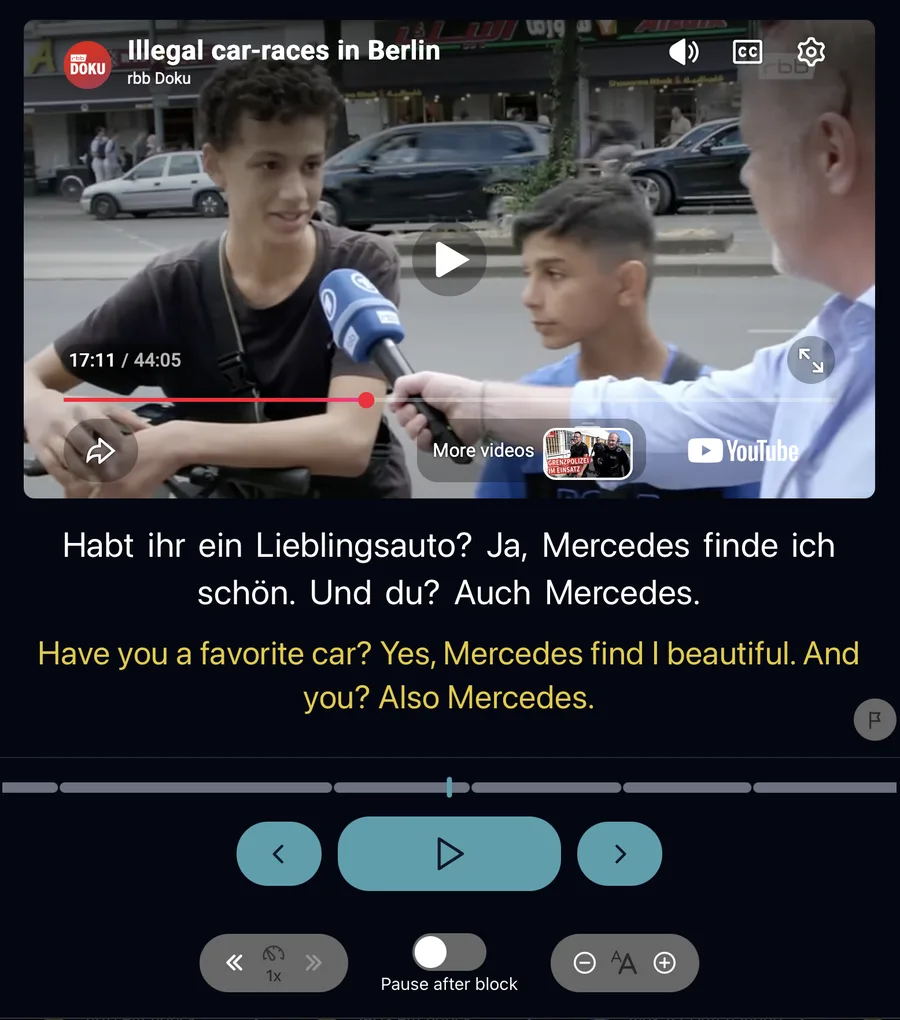
- Chinese (Simplified) in white, the translation underneath in yellow
- Tap a word to see what it means
- Slow it down, or pause after each line
 99 min专访许成钢:极权体制下的经济奇迹与困局|局面访谈20241221王志安 · 5.68m views
 29 min为何中国疯狂扫黄?看完你就明白了,太毁三观了!#许知远 #纪实风云 #纪录片 #罗翔纪实风云 · 2.11m views
 43 min【年度总结】一口气了解过去一年的全球经济|关税战新格局小Lin说 · 1.89m views
 9 min9分钟游遍西安:世界四大古都之一的西安,如今长什么样子?Xi'an:one of the world's four ancient capitals, look like today??兩顆太陽Show · 1.31m views
 37 min500份泄密档案+3000份合同,扒出中国百亿舆论管控系统真相 20261016【新闻大写】王志安 · 894k views
 32 min【胡锦涛纪录片】中国最强“小镇做题家” | 出身贵族的儒雅贤君,抑或是平庸之恶?他究竟是被架空的帝王,还是文景再世?| 中共 | 江泽民 | 习近平 | 中国政治VEXILLA潮時務所 · 528k views
3 more from October 2026


In the app, your first 30 minutes of listening are free. listening.lingophant.com is free in any browser.
Longer listening
Documentaries
Clear, well-edited Chinese (Simplified), for when a short clip starts to feel easy.
小Lin说2.84m subscribers · 10 videos
Hi~ 我是Lindsay,欢迎来到我的频道!希望能跟大家一起乐乐呵呵涨点知识~~


王志安 2.05m subscribers · 10 videos
这里是中国著名的调查记者王志安在YouTube上开设的账号,王局早年在中国CCTV知名的调查栏目《新闻调查》担任出镜记者,2017年,王局从央视辞职,创办了新闻人物访谈节目《局面》,2019年,王局被中国政府全网封杀,社会性死亡。2020年,王局东渡日本,并在YouTube上开设…
 35 min美国公布东航空难数据现真相,副机长自S,131人陪葬!|NTSB|中国民航总局|黑匣子|信息公开|5735航班|王局拍案202605042.59m views
 38 min谁在举报郭德纲?|相声|莫须有|红歌|李昊时|王局拍案202608191.42m views
 34 min没参保的人在哪里,国家在找你!|灵活就业|公务员|养老金|强制社保|劫贫济富|王局拍案202610131.75m views
7 more from 王志安
 35 min男人觉得越来越贵,女人觉得他不配:现代中国男女对立的根源是什么? 20260828【新闻大写】1.04m views
 30 min啊,英语|王局拍案202609211.06m views
 36 min摄像头下的官场现形记|王局拍案202609291.70m views
 29 min刘翔怒怼上海体育局,他想走的第三条路是什么?|耐克|广告分成|奥运冠军|王局拍案20260901 1.11m views
 29 min杭州电梯诬陷案,事主被拘留!|小作文|男女对立|养狗纠纷|王局拍案202609021.16m views
 34 min最狠VPN翻墙新规落地:千亿审查系统对决民间极客,未来我们还能翻墙吗? 20260508【新闻大写】1.56m views
 30 min朱镕基去世,中国的改革开放,是洋务运动还是明治维新?|龙安志|江泽民|王局拍案202608131.18m views
5 more channels: 柴静 Chai Jing · 环华十年 · 阿树Atlas Explore China …
柴静 Chai Jing1.22m subscribers · 6 videos
柴静 Chai Jing 记者


环华十年335k subscribers · 9 videos
培根2016年4月1日出发,开始环中国旅行。十年时间,走遍中国的每一片土地,用镜头记录10年旅途的所见所闻,分享10年的个人成长。
 24 min广州日结大神,一天工资2033块,在这里阳光也需要花钱?1.02m views
 32 min中国第一代躺平青年,深圳的流浪汉“三和大神”到底在想什么?640k views
 14 min不去台湾不回大陆,他们成了留在东南亚的华人难民!探访泰国北部最大华人村“大谷地”627k views
6 more from 环华十年
 11 min【环华十年|实拍】疫情影响下,西安300多户业主住进烂尾楼!987k views
 16 min广州一本大学毕业女生:很后悔没有早点摆摊,早点去认清社会的现实!223k views
 12 min冒死实拍金三角诈骗园区,街上的黄赌毒产业都是公开的,背后做的事才吓人!130k views
 28 min广州10年网约车老司机,腿瘸了也没办法,这就是底层人的命!177k views
 29 min大凉山那个住在悬崖上的村庄如今怎么样了?要进这个村真是难如登天!117k views
 17 min【探秘非洲狩猎部落】跟随狩猎部落去打猎,没想到他们最后抓这个动物来吃|非洲原始部落|Hadzabe|狩猎172k views
阿树Atlas Explore China222k subscribers · 7 videos
商務合作Email: zoudashan1960@163.com
 27 min实拍中国最冷城市,最低温度-58°C,每年供暖9个月,没有冰箱和空调,老人都有退休金花不完,冰雪中的根河早市,大兴安岭的山珍野味,大开眼界🇨🇳【阿树闯东北】EP392.50m views
 56 min冒死挑战中国最危险的悬崖村,2500多级近乎垂直钢梯,爬到山顶见闻大受震撼!丨四川大凉山丨美姑县丨中国旅游丨悬崖村庄丨彝族丨阿树1.08m views
 37 min独闯中国俄罗斯族村🇨🇳🇷🇺80年前苏联寡妇越过界江,与汉族男子组成家庭,今天边疆村300多人,约一半是混血,接近北极圈冬天均温零下30度,只剩几户人家留守,与俄罗斯波亚尔科沃隔江相望丨闯东北EP28916k views
4 more from 阿树Atlas Explore China
 27 min實拍中國大涼山深處,中國最壯觀的節日,真正的刀山火海!普格縣火把節全紀錄🇨🇳四川大涼山丨大涼山彝族自治州丨彝族丨中國旅遊丨少數民族節日丨阿樹825k views
 46 min中朝俄三国边境市集,中国最大朝鲜族市场,摊主讲朝鲜语,延吉市水上市场和西市场🇨🇳狗肉汤、参鸡汤、炒米肠、鱼皮包饭、韩式炒米糕、鱼饼、黑包子、打糕、辣白菜、人参松茸、酱蟹、长白山山货【阿树闯东北】EP7688k views
 25 min中国缅甸边境的原始菜市场,傣族、景颇族美食看呆,云南芒市的物价巨便宜!9元自助餐竟如此丰盛!4K Eng Subtitle465k views
 48 min独闯中国朝鲜边境乡村,住满6个月国家就发钱,举报偷渡奖励3000元,90%村民说朝鲜语,子女多去韩国打工,房屋破败几无人烟,中国最边缘的乡村之一🇨🇳🇰🇵【阿树闯东北】EP9597k views
腾讯视频 – 纪录片 – Get the WeTV APP145k subscribers · 5 videos
欢迎来到腾讯视频 – 纪录片频道,这里有天南海北的美食,也能带你品味人生的百态。题材涉及美食、美食文化、历史、社会现实、人文生活、青年文化…【欢迎订阅】▶▶▶
 28 min【蚝油的鲜味传奇 Oyster Sauce: A Drop of Umami】EP01 | “鲜”入为主 |MULTI SUB66k views
 32 min【了不起的妈妈 Marvelous Moms】EP01 | 洛杉矶 静涵: 学霸妈妈的“冠军”养成计划7k views
 58 min【前浪 第2季 The Silver Tide S2】EP01 | 我在天堂等你6k views
2 more from 腾讯视频 – 纪录片 – Get the WeTV APP


歪脑WHYNOT48k subscribers · 3 videos
深度。视觉。无审查。



Grammar summaries
Noticing patterns?
You’ll notice these patterns while practising phrases. Each chapter is a short explanation and the best videos we found.
A1Basic Sentence Order: Subject-Verb-Object
Chinese sentences follow a Subject-Verb-Object (SVO) word order that is very consistent, making it one of the most learner-friendly aspects of the language. Unlike many European languages, Chinese has no verb conjugations, no gendered nouns, and no plural endings — the verb stays the same no matter who is doing the action or when. For example, 我吃饭 (wǒ chī fàn) means 'I eat rice/a meal,' and you simply swap the subject to say 他吃饭 (tā chī fàn) for 'He eats.' Time words like 'today' or 'yesterday' slot naturally before the verb: 我今天吃饭 (wǒ jīntiān chī fàn). Context handles most of what English marks with verb tense.
A great learning technique is to treat each phrase in the app as a mini-template: identify the subject, the verb, and the object, then swap in new words to generate dozens of new sentences. Because Chinese relies so heavily on context and word order rather than inflection, mastering this basic skeleton immediately lets you construct and understand a huge range of everyday statements — ordering food, describing what people do, and following the plot of any conversation you hear.
- Chinese Sentence Structure – Chinese Grammar Simplified 101 · Twin Cities Chinese Tutor
- Chinese Grammar: 80% of Chinese Sentences Follow This ONE Rule! · ShuoshuoChinese说说中文
- Chinese Sentence Structure: How to make sentences in Chinese Mandarin? Word Order in Chinese · Andy and Sarah Mandarin
A2Aspect Particles: 了, 过, and 着
Chinese does not conjugate verbs for tense, but it uses small particles placed after verbs to show the aspect — that is, how an action relates to time and completion. The three most common are 了 (le), which signals a completed action or a new situation (我吃了 wǒ chī le — 'I've eaten'); 过 (guò), which marks a life experience (我去过北京 wǒ qùguò Běijīng — 'I've been to Beijing before'); and 着 (zhe), which shows an ongoing state (他站着 tā zhàn zhe — 'He is standing'). It is important to understand that 了 does not simply mean 'past tense' — it can appear with future events too (你吃了再走 'eat first, then go'), so focus on the idea of completion or change, not just 'past.'
A useful trick is to memorise one anchor sentence for each particle and notice how native speakers use it in the app's phrases. Think of 了 as a 'done' stamp, 过 as a 'been there' badge, and 着 as a '-ing' state-holder. Once you internalise these three particles, you can accurately describe what you have done, what you have experienced in your life, and what is currently happening around you — three of the most essential things any real conversation requires.
A1Measure Words (量词)
In Chinese, you cannot place a number directly before a noun the way English does. Instead, you must insert a measure word (量词, liàngcí) between the number and the noun. The pattern is: Number + Measure Word + Noun. For example, you say 一本书 (yī běn shū, 'one [volume] book') or 三个人 (sān gè rén, 'three [general] people'). Different nouns require different measure words: 条 (tiáo) is used for long, flexible things like fish or rivers; 张 (zhāng) for flat objects like paper or tables; and 个 (gè) is the all-purpose measure word that works in most situations when you are unsure.
The best strategy for beginners is to learn each new noun together with its measure word as a chunk, the same way you learn a phrase in the app — rather than trying to memorise a list of rules. When in doubt, 个 will almost always be understood by a native speaker, so it is a reliable fallback. Internalising measure words allows you to count and quantify anything in conversation, ask 'how many,' go shopping, describe quantities of food and objects, and sound natural rather than like someone translating directly from English.
- Explain why MEASURE WORD in Chinese and HOW to remember them fast ! · Yimin Chinese艺敏中文
- 8 Common Chinese Measure Words You Must Know #Day 22 Chinese Classifiers · Everyday Chinese
- Chinese Measure Words 量词 – Chinese Grammar Simplified 205 · Twin Cities Chinese Tutor
A1Forming Questions: 吗 and Verb-Not-Verb
Chinese offers two clean, high-frequency ways to ask yes/no questions. The first is to take any statement and add the particle 吗 (ma) to the end: 你是学生 (nǐ shì xuésheng, 'You are a student') becomes 你是学生吗? ('Are you a student?'). The second method, which sounds more natural in many spoken contexts, is the 'verb-not-verb' (A-not-A) pattern: you repeat the verb with 不 (bù) in between, for example 你是不是学生?or 你去不去?(nǐ qù bu qù, 'Are you going or not?'). Both forms are extremely common, but 吗 questions are simpler to build at first.
Think of 吗 as a question mark you can hear, and the A-not-A pattern as the spoken equivalent of raising your eyebrows and presenting two options. Listening for 吗 at the end of a sentence in the app is your cue that someone is asking something — which trains your ears fast. Once you control these two patterns, you can turn any statement you already know into a question, which doubles your conversational toolkit immediately and lets you verify information, make requests, and check understanding in any everyday situation.
- How easy is it to make question sentences in Chinese! · HSK Test Preparation and Practice
- How to Use 是不是? \\ Chinese Grammar (YES/NO Questions Part 2) · ABChinese
- Chinese Lesson Ep.11 : How to ask YES / NO Question in Chinese · Little Today
A1Negation with 不 and 没
Chinese uses two main negation words, and choosing the right one depends on what you are negating. 不 (bù) is used to negate present habits, preferences, intentions, adjectives, and most verbs: 我不喝酒 (wǒ bù hē jiǔ, 'I don't drink alcohol') or 他不高兴 (tā bù gāoxìng, 'He's not happy'). 没 (méi) is used to negate completed actions and the verb 有 (yǒu, 'to have'): 我没吃 (wǒ méi chī, 'I didn't eat / haven't eaten') and 我没有时间 (wǒ méiyǒu shíjiān, 'I don't have time'). A common mistake is using 不 with completed actions — remember that 没 pairs with the idea of something not having happened.
A simple mental rule: if the situation could take the completion particle 了, use 没 to negate it; otherwise, use 不. Practise by negating phrases you already know from the app — this habit quickly makes negation feel automatic. Mastering these two words immediately lets you decline invitations, express that you lack something, describe what did or didn't happen, and push back on assumptions — all of which are indispensable in everyday conversation.
- Chinese Grammar: 不(bù) VS 没 (méi) 8 clear rules to use them correctly without mistake. · Yimin Chinese艺敏中文
- Learn Chinese HSK Grammar – Difference Between 不 and 没 · HSK Test Preparation and Practice
- 【不 and 没】Still Confused About 不 VS 没(bù VS méi)|CHINESE GRAMMAR汉语语法 · Yidianr Chinese
A2Topic-Comment Structure
One of the defining features of natural Chinese speech is the topic-comment structure, where the speaker first names the topic and then makes a comment about it — often resulting in sentences that feel 'backwards' to English speakers. For example: 这道菜我很喜欢 (zhè dào cài wǒ hěn xǐhuān, literally 'This dish, I really like [it]') or 钱我没有 (qián wǒ méiyǒu, 'Money, I don't have'). The 'topic' is what the sentence is about, and it gets promoted to the front, while the grammatical subject and verb follow. This is not a special construction — it is simply how Chinese naturally frames information.
To tune your ear, notice in the app when an object or location appears at the very start of a sentence before the subject — that is almost always a topic-comment sentence. Try reformulating sentences by moving the object to the front and see if the meaning still works. Understanding this structure lets you follow the natural flow of Chinese speech without getting confused when sentences seem to start 'in the middle,' and it allows you to produce the kind of nuanced, emphasis-driven sentences that native speakers use constantly in conversation.
- Topic Comment Structure in Mandarin Chinese [Grammar] · I Heart Mandarin
- Sound More Natural with Topic-Comment Structures – Chinese Grammar Lesson · Skritter
- Want to sound Chinese enough? Use topic-comment structure! · Outmaze Chinese
B1The 把 Construction for Object-Handling
The 把 (bǎ) construction is a grammatical pattern used when you want to describe what someone does to an object — especially when the action has a clear result, movement, or disposal. Instead of the normal Subject-Verb-Object order, 把 moves the object before the verb: Subject + 把 + Object + Verb + Result/Complement. For example, 我把作业做完了 (wǒ bǎ zuòyè zuòwán le, 'I finished the homework [completed it]') or 请把门关上 (qǐng bǎ mén guān shàng, 'Please close the door'). The verb in a 把 sentence almost never stands alone — it needs a complement showing what happened to the object as a result of the action.
Think of 把 as a way of saying 'deal with' or 'handle': you are taking the object and doing something decisive with it. A good learning habit is to look for 把 in app phrases and immediately identify the object being 'handled' and the result that follows. Once you control this pattern, you can give precise instructions, describe completed tasks, explain how you arranged or moved things, and understand the kinds of detailed directions and requests that appear constantly in both conversation and written Chinese.
B1Result and Degree Complements
Chinese uses a rich system of complements — words or phrases that follow a verb to add information about the result, direction, or degree of an action. Result complements attach directly after the verb: 听懂 (tīng dǒng, 'listen and understand'), 写完 (xiě wán, 'write and finish'), 说错 (shuō cuò, 'say wrongly'). Degree complements, introduced by 得 (de), describe how well or intensely something is done: 他跑得很快 (tā pǎo de hěn kuài, 'He runs very fast'), or in the negative, 他说得不清楚 (tā shuō de bù qīngchǔ, 'He doesn't speak clearly'). The potential form inserts 得 or 不 between the verb and its result complement to mean 'can' or 'cannot': 听得懂 / 听不懂 (can / cannot understand by listening).
Spot complements in the app by looking for syllables glued directly after a verb — they are almost never stand-alone words in that position. Chunk the whole verb-complement pair as one unit (e.g., 'tīng dǒng' = understand by listening) rather than trying to translate word by word. Mastering complements is a major leap in fluency: you can suddenly describe outcomes precisely ('I finished it,' 'I didn't get it,' 'she sings beautifully'), which is what separates stilted, simple speech from the nuanced, expressive Chinese that real conversations demand.
A2Modifying Nouns with 的 (de)
In Chinese, any modifier — whether a single adjective, a possessive, or an entire clause — comes before the noun it describes and is linked to it with 的 (de). This means relative clauses go before the noun, which is the opposite of English. 'The book that I bought' becomes 我买的书 (wǒ mǎi de shū, literally 'I-bought 的 book'). Possessives work the same way: 我的朋友 (wǒ de péngyou, 'my friend'). Even complex descriptions follow this rule: 昨天在咖啡店看书的那个男人 ('the man who was reading in the café yesterday') — all the descriptive information piles up before 男人 (man). Once you see this pattern, enormous chunks of Chinese text that previously seemed chaotic will suddenly resolve into clear structure.
Train yourself to search for the noun at the end of a phrase and work backwards — everything before 的 is describing that noun. In the app, highlight 的 whenever you see it and practise identifying what noun it is pointing toward. This single insight dramatically improves your reading and listening comprehension, and it enables you to produce detailed, complex descriptions of people, places, and things — moving you from 'I see a man' to 'I see the tall man who works in the shop next to my house.'
- how to use 🙌的de(Chinese grammar)| Learn Mandarin Chinese with Yimin · Yimin Chinese艺敏中文
- [ 的 clause] How to use 的 to modify anything in Mandarin Chinese? · I Heart Mandarin
- Modify a noun by a clause in Chinese #learningmandarin #learnchinese #chineseonlinecourse · Holly Mandarin TW