
Learn Catalan
Hola com estàs? Phrases to say and videos to understand, all free to start. Time on this page counts towards your streak.
Phrase sets
Say it without thinking
9 sets of everyday Catalan, with audio for every phrase. Add a set to the app and practise it there.
- Tap “Add phrases to app”Start with set 01.
- Tap Download in the appThe phrases land on your phone, with audio.New phraseset unlockedDownload all phrases to your phone?CancelDownload
- Practise 12 at a timeThe app tests you on 12 phrases at a time and schedules the next time you see each one.12phrases per batch,
spaced repetition
- Click “Check out phrases”The phraseset page opens. Listen to every phrase there.
- Scan the QR code with your phone’s cameraThe Lingophant app opens and asks to download the set. No app yet? The link takes you to the store first.
- Practise 12 at a timeThe app tests you on 12 phrases at a time and schedules the next time you see each one.
01 · Basic Phrases
17 phrases02 · Introductions
20 phrases03 · Useful Reactions
26 phrases6 more sets: Clarifications · Learning Languages · Interests, Opinions, Preferences …
04 · Clarifications
17 phrases05 · Learning Languages
20 phrases06 · Interests, Opinions, Preferences
23 phrases07 · Travel Phrases
21 phrases08 · Smalltalk
22 phrases09 · Politeness
8 phrasesWhere all 9 sets get you: 174 phrases
Your first 30 phrases are free, then 3 new phrases a day, or Premium for as many as you like. No account needed for your first two sets.
Longer listening
Documentaries
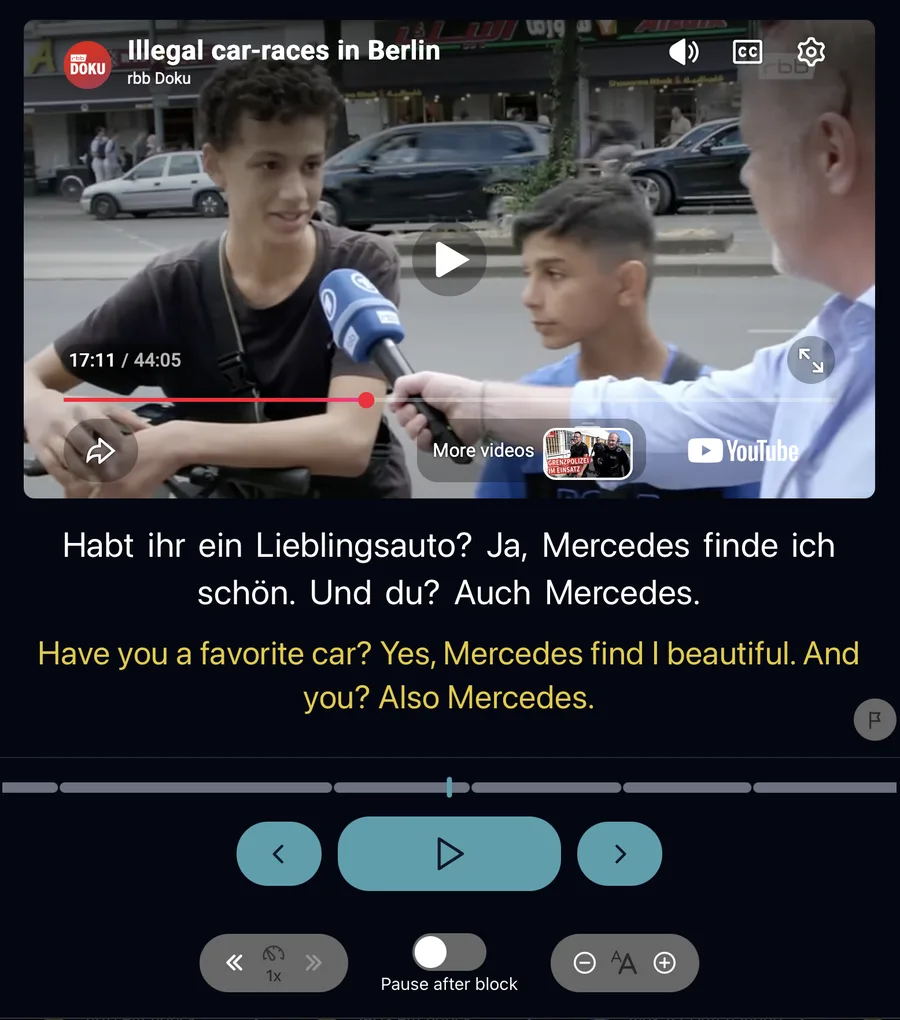
- Catalan in white, the translation underneath in yellow
- Tap a word to see what it means
- Slow it down, or pause after each line
Clear, well-edited Catalan, for when a short clip starts to feel easy.
3Cat491k subscribers · 1 video
#Som3Cat, passeu, passeu!

À Punt Mèdia59k subscribers · 5 videos
Benvinguts i benvingudes al canal oficial d'À Punt Radiotelevisió Valenciana en YouTube.



4 more channels: betevé · ICGC Catalunya · Barcelona.cat …
betevé44k subscribers · 7 videos
Hola i benvinguts al canal de YouTube de betevé!
 29 minObjectiu Sagrada Família: Tocar el cel [Episodi 1]89k views
 14 minLa història de 'El Torete' | BCN CONFIDENCIAL49k views
 52 minPEDRALBES: DESPERTANT LA REINA | DOCUMENTAL PUNT DE FUGA | BETEVÉ8k views
4 more from betevé
 20 minMercat dels Encants: història, arquitectura i secrets de la subhasta a Barcelona1k views
 21 minCentre Municipal de Vela amb Pol Casellas. Arquitectura olímpica, mar i reforma al Port Olímpic732 views
 14 minEL CRIM DE SONIA RESCALVO | BCN CONFIDENCIAL | betevé10k views
 17 minEL MISTERI DEL MORT DE L'AEROPORT DEL PRAT | BCN CONFIDENCIAL25k views
ICGC Catalunya40k subscribers · 10 videos
L'Institut Cartogràfic i Geològic de Catalunya (ICGC) és un organisme que entra en funcionament l’1 de febrer de 2014, i les funcions del…
 33 minLa mesura de la Terra52k views
 81 min"Riscos geològics a Catalunya: els seus efectes i la seva mitigació", de 27 d'octubre de 20202k views
 75 min"Vistes panoràmiques, cartes militars i plànols urbanístics a Barcelona del segle XVI al XIX"434 views
7 more from ICGC Catalunya
 82 minJornada “Espaigea. Els Geoparcs Mundials de la UNESCO de Catalunya", 19 d'abril de 2023302 views
 44 minPresentació de l'exposició "El món amb ulls de dona" de 27 d'abril de 2021292 views
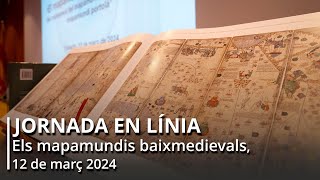 44 minPresentació del llibre "Els mapamundis baixmedievals", 12 de març de 2024217 views
 69 minJornada "Delimitació municipal a l'Alt Pirineu i Aran", 10 de juny de 2021.320 views
 100 minConferència "L'emergència climàtica: gràfics, mapes i imatges", a càrrec del Dr. Javier Martín Vide255 views
 68 minConferència "Recursos, serveis i eines en l'àmbit digital per a excursionistes",de 15 de juliol 2020735 views
 54 minPresentació del llibre i de l’exposició “GEAS: Dones que estudien la Terra”, en català, 9.02.23237 views
Barcelona.cat20k subscribers · 1 video
Canal oficial de l'Ajuntament de Barcelona. #barcelona

EVA19k subscribers · 8 videos
EVA és la teva comunitat de referència en català.
 75 minCastells: rivalitat, secrets i tradició, amb Gina Fort, Alba Esteve i més | La turra6k views
 68 minEs pot fer cultura catalana en castellà? Amb Kneecap, Eduard Sola i més | La turra17k views
 77 minTrencar amb la família, amb Belén Barenys, Laura Galve i més | La turra (T5XC33)24k views
5 more from EVA
 60 minLa crisi dels 30, amb Carles Francino, Iñaki Mur i més | La turra10k views
 73 minL'ocupació és justa? Amb Mamadou Yero, Núria Moliner i més | La turra11k views
 15 minExisteix un Pirineu sense neu? | Era plaça (T1xC1)713 views
 15 minPagesos, supermercats i consciència: què hi ha al plat? | Era Plaça (T1xC2)424 views
 79 minInfluencers en crisi? Amb Dulceida, Alicia Revilla i més | La turra (T5XC30)14k views
Grammar summaries
Noticing patterns?
You’ll notice these patterns while practising phrases. Each chapter is a short explanation and the best videos we found.
A1Ser vs. Estar: Two Ways to Say 'To Be'
Catalan, like Spanish, splits the English verb 'to be' into two verbs: 'ser' and 'estar'. 'Ser' describes permanent or defining qualities — identity, origin, profession, and inherent characteristics (e.g., 'Soc català' — I am Catalan; 'És metge' — He is a doctor). 'Estar' describes temporary states, locations, and conditions that can change (e.g., 'Estic cansat' — I am tired; 'Està a Barcelona' — She is in Barcelona). The key distinction is that 'ser' answers 'what kind of thing is this?' while 'estar' answers 'what state or position is it in right now?'.
A reliable trick is to ask yourself: would this change tomorrow? If yes, use 'estar'. Memorise a handful of fixed chunks from the app — like 'estic bé' (I'm fine), 'sóc d'aquí' (I'm from here), and 'és tard' (it's late) — and let patterns emerge naturally from exposure. Once you internalise this distinction, you will immediately understand and produce basic descriptions of people, places, and feelings, which are the backbone of almost every real conversation.
- Learn Catalan language: verb To Be (Ser & Estar) · Learn Catalan from Barcelona
- Learn Catalan: flavours & verb ser and estar (easy) · Learn Catalan from Barcelona
- Learn Catalan: personal pronouns and verb to be (ser) · Learn Catalan from Barcelona
A1Present Tense of Regular Verbs
Catalan verbs are grouped into three conjugation classes based on their infinitive endings: -ar (e.g., parlar — to speak), -er/-re (e.g., beure — to drink), and -ir (e.g., dormir — to sleep). In the present tense, each class follows a predictable set of endings. For -ar verbs: parlo, parles, parla, parlem, parleu, parlen. The -er and -ir groups have their own patterns, and once you learn one verb in each group, you can apply those endings broadly. Catalan also drops subject pronouns far more often than English, so 'parla' alone can mean 'he speaks', 'she speaks', or even 'you speak' depending on context.
The best strategy is to anchor each class to one high-frequency model verb — use 'parlar' for -ar, 'tenir' for -er irregulars, and 'obrir' for -ir — and drill those models until they feel automatic. As you encounter new vocabulary in the app, mentally slot each verb into its class. Mastering the present tense unlocks the ability to talk about your daily routines, describe what people do, and understand most of the conversations you will hear around you.
A1Articles, Gender, and Number Agreement
Every Catalan noun has a grammatical gender — masculine or feminine — and this gender ripples through the entire noun phrase, affecting articles, adjectives, and pronouns. The definite articles are 'el' (masculine singular), 'la' (feminine singular), 'els' (masculine plural), and 'les' (feminine plural), with 'l'' used before vowels (e.g., l'hora). The indefinite articles are 'un' and 'una'. Adjectives must match the noun in both gender and number: 'un gat negre' (a black cat, masculine) vs. 'una gata negra' (a black cat, feminine). Most feminine nouns end in -a and most masculine nouns in -o or a consonant, though there are exceptions.
Rather than trying to memorise gender rules abstractly, always learn every new noun together with its article — store 'el cotxe' in your memory, not just 'cotxe'. The app's phrases naturally embed articles, so pay attention to the article as part of the word chunk. Once gender and number agreement click, you will sound far more natural in Catalan and will stop making the jarring mismatches that mark beginner speech.
A2The Periphrastic Past (Anar + Infinitive)
One of the most distinctive features of Catalan is how it expresses the simple past. Instead of a complex synthetic past tense, everyday spoken Catalan uses 'anar' (to go) in the present tense + an infinitive: 'vaig menjar' literally means 'I go eat' but translates as 'I ate'. This construction — called the periphrastic past — is the dominant past tense in conversation and informal writing. You conjugate 'anar' (vaig, vas/vares, va, vem/vàrem, veu/vàreu, van/varen) and add any verb in its infinitive form. 'Va trucar' means 'she called'; 'van arribar' means 'they arrived'.
Think of 'vaig + infinitive' as a single past-tense stamp you apply to any verb — it is enormously productive because it works with every verb without irregular forms to memorise. Practise by taking present-tense sentences from the app and converting them to past by swapping the conjugated verb for 'anar + infinitive'. Once you control this pattern, you can recount stories, talk about what happened yesterday, and understand the great majority of spoken narratives in Catalan.
A2Weak (Clitic) Pronouns: Direct and Indirect Objects
Catalan has a rich system of short unstressed pronouns — called clitic or weak pronouns — that replace object nouns and attach to verbs. Direct object pronouns include 'el', 'la', 'els', 'les' (him/her/it/them) and 'em', 'et', 't', 'ens', 'us' (me, you, us). Indirect object pronouns include 'li' (to him/her) and 'els' (to them). These pronouns sit before conjugated verbs ('el veig' — I see him) but attach after infinitives and imperatives ('veure'l' — to see him; 'digues-li' — tell him). The pronoun 'en' replaces partitive expressions or complements introduced by 'de', and 'hi' replaces place expressions or complements introduced by 'a' — both are very frequent and uniquely Catalan.
Focus first on 'em', 'et', 'el', 'la', 'li', 'hi', and 'en' as these seven cover the vast majority of real usage. Notice in the app how native phrases avoid repeating nouns — 'li ho dono' (I give it to him) packs a full meaning into three tiny words. Mastering clitic pronouns is the single biggest leap towards sounding natural, because they appear in almost every sentence and learners who avoid them sound stilted and overly formal.
A2Modal Verbs: Poder, Voler, Haver de, and Cal
Catalan uses several key modal constructions to express ability, desire, obligation, and necessity. 'Poder' (can/to be able to) + infinitive expresses ability or permission: 'puc ajudar-te' (I can help you). 'Voler' (to want) + infinitive expresses desire: 'vull menjar' (I want to eat). 'Haver de' (to have to) + infinitive expresses personal obligation: 'he de treballar' (I have to work). The impersonal 'cal' (it is necessary) + infinitive or noun is extremely common in signs, instructions, and polite requests: 'cal reservar' (reservation required / you need to book). These four constructions handle the majority of modal meaning in everyday speech.
Learn each modal as a fixed chunk paired with a common infinitive — 'puc parlar' (I can speak), 'vols venir?' (do you want to come?), 'hem d'anar' (we have to go) — and expand from there. Because modals combine with any infinitive, controlling them multiplies your expressive power dramatically. With these patterns you will be able to make requests, express preferences, state what is allowed or required, and navigate practical situations like ordering food, asking for help, and reading public notices.
B1The Subjunctive: Common Triggers and Everyday Use
The subjunctive mood in Catalan is used to express wishes, doubts, emotions, recommendations, and hypotheticals — and it is triggered by specific conjunctions and verb types. The most frequent triggers are: 'que' after verbs of wanting/wishing ('vull que vinguis' — I want you to come), 'que' after impersonal expressions ('cal que ho sàpigues' — you need to know this), conjunctions like 'perquè' meaning 'so that' ('t'ho dic perquè ho entenguis'), 'quan' in future contexts ('quan arribi' — when he/she arrives), and negative commands ('no ho facis' — don't do it). The present subjunctive is formed by taking the first-person singular present, dropping the -o, and adding a new set of endings.
Rather than learning the subjunctive as an abstract paradigm, treat it as a signal: whenever you hear 'vull que', 'espero que', 'és important que', or 'quan' + future meaning, expect a subjunctive to follow. Collect these trigger phrases from the app as fixed chunks and gradually notice the verb forms that follow. Once you recognise and produce the most common subjunctive patterns, you will be able to express nuanced wishes, give polished advice, and understand a huge range of natural Catalan speech that would otherwise sound baffling.
B1Relative Clauses: Que, On, and El Qual
Relative clauses let you combine two sentences into one, describing a noun more precisely. In Catalan, the all-purpose relative pronoun is 'que', used for both subjects and direct objects: 'la dona que parla' (the woman who is speaking), 'el llibre que llegeixo' (the book that I am reading). For places, 'on' (where) is used: 'la casa on visc' (the house where I live). After prepositions, you use 'el qual / la qual / els quals / les quals' or 'qui' (for people): 'la persona amb qui parles' (the person you are talking to), 'l'empresa per a la qual treballo' (the company I work for). In everyday speech, 'que' handles the great majority of cases.
Start by mastering 'que' in its two roles — relative subject and relative object — because this single word will cover about 80% of the relative clauses you encounter. A useful exercise is to take two short sentences from the app and practise merging them with 'que'. Once you control relative clauses, your speech gains texture and precision: you can describe things without resorting to a series of short choppy sentences, which is a hallmark of fluent, natural Catalan.
- Les oracions de relatiu. Part 1 (1/3) · Classe de Valen
B2Conditional Tense and Hypothetical Sentences
The conditional tense in Catalan expresses what would happen and is formed by adding the endings -ia, -ies, -ia, -íem, -íeu, -ien to the infinitive (the same stem used for the future): 'parlaria' (I would speak), 'vindria' (he/she would come), 'faríem' (we would do). Hypothetical sentences pair the conditional with the subjunctive: 'Si tingués temps, viatjaria més' (If I had time, I would travel more) uses the imperfect subjunctive in the 'si' clause and the conditional in the result clause. For more realistic conditions about the future, Catalan uses 'si' + present indicative + future: 'Si véns, ho celebrarem' (If you come, we will celebrate it).
Focus first on the conditional endings — because they are completely regular and attach to the infinitive, you only need to memorise one set of endings for all verbs (with a handful of irregular stems like 'hauria', 'seria', 'faria'). Practise by converting phrases from the app into hypotheticals: 'vull fer-ho' becomes 'voldria fer-ho' (I would like to do it), which is also a key politeness strategy. With the conditional, you gain the ability to make polite requests, discuss plans and possibilities, and engage in the kind of nuanced, hypothetical conversation that defines genuine fluency.