

🇬🇪 Georgian
Introductory Course Content
Understand the elementary concepts of the language, train your listening
intensely, and build a basic vocabulary of ca. 100 phrases. From there you can
grow your personal vocabulary over time. It takes around one month if you spend 40 minutes every day.
Download our mobile app to practice with audio, access this page easily, and track your progress. We used Georgian as proof that our method works and are convinced now that there’s no better way to learn.
Overview Of Course Material
Welcome 🎊! (click to expand)
This course helps you develop the critical skills for success in Georgian in a unique and effective way, through:
- Listening training for recognising words when people speak fast, while getting to know interesting people.
- The verb-system explained in ca. 20 short videos, which is the most complex part.
- Phrases to practice on our app, so you can correct things with confidence and good pronunciation.
- Essential grammar concepts explained from the perspective of experienced language learners.

Also, join our WhatsApp group if you want some practice. You can talk to us directly, ask questions, and we have a few speaking sessions every week.
Week 1+2
🧑🏫 Why is Georgian difficult and easy at the same time?
It’s difficult because it has a unique system, sounds, and script. That makes listening, recognizing and remembering words challenging.
Especially the verb system requires clear explanations.
And moving from reading word-by-word instead of letter-by-letter takes a long time, making media consumption tough.
Luckily it’s also simple. There are no genders and the verb system can be simplified and become natural.
The same roots are used for creating many other words in a poetic, visual, and somewhat standardized way. This makes learning and speaking fun.
As an encouragement: Most Georgians don’t use perfect grammar either.
And the feedback they show you for even trying to learn their small language will make it very rewarding.
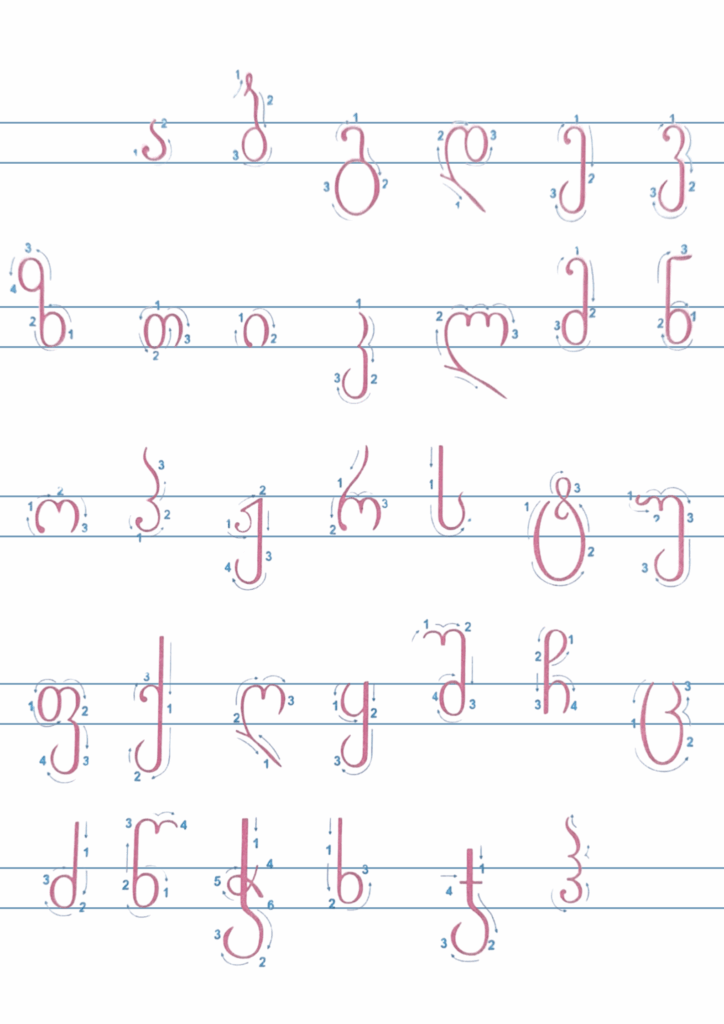
🧑🏫 A lazy guide to the alphabet (with tricks to remember each letter)
Normally you’d spend the first 2-3 weeks with your teacher learning the script.
With us you watch this video twice and start practicing phrases on the app.
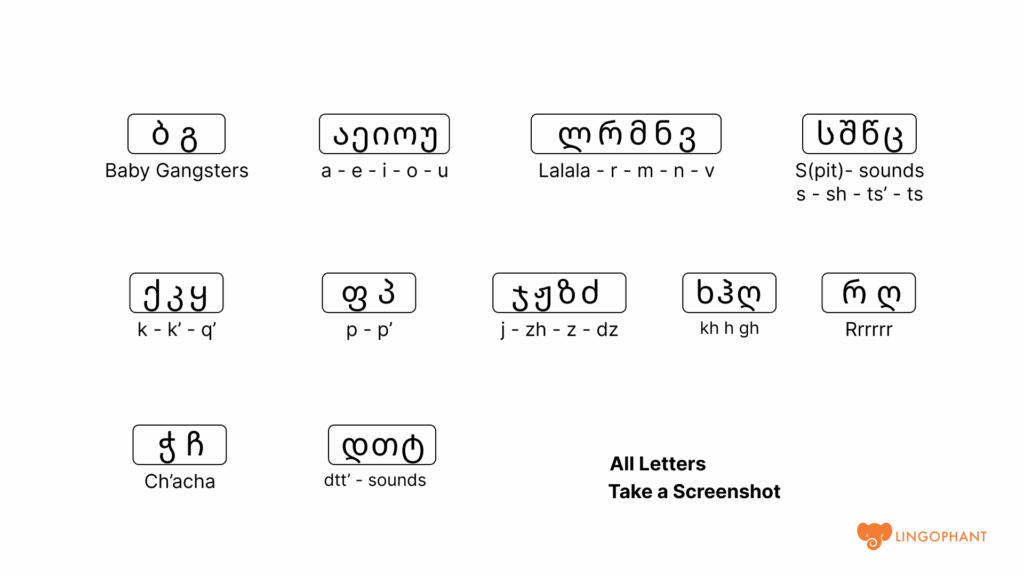
Every letter has a hint to remember it.
If you prefer learning from a book, here is the book most teachers use.
But take a look at our video first.
All Letters
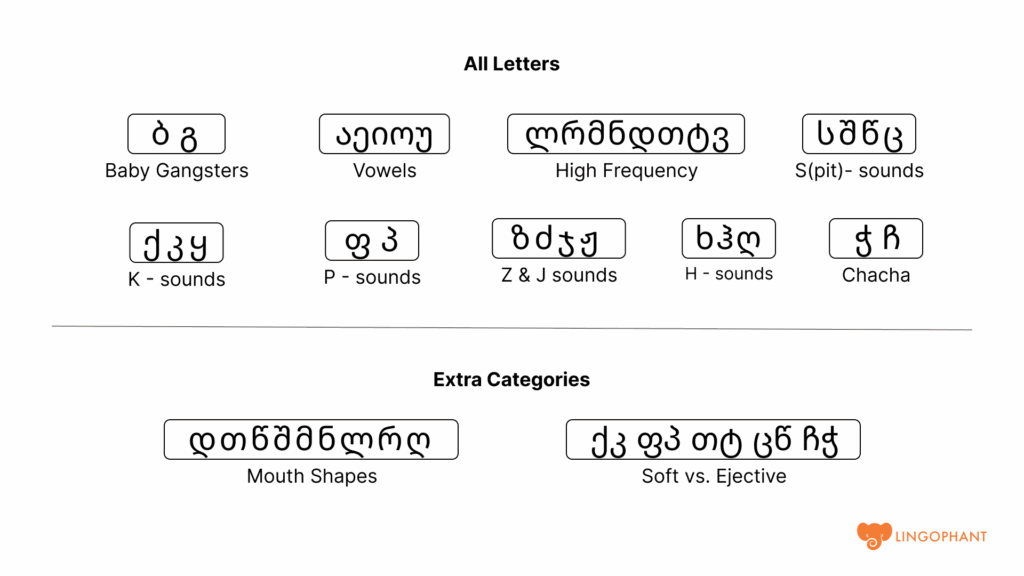
Two overviews to help you:
Georgian Introductory Course
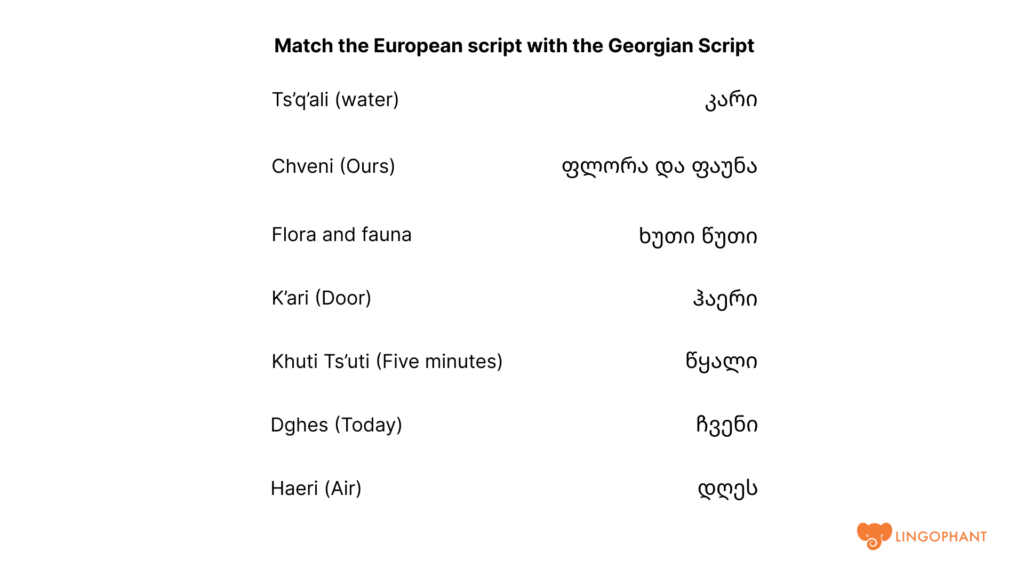
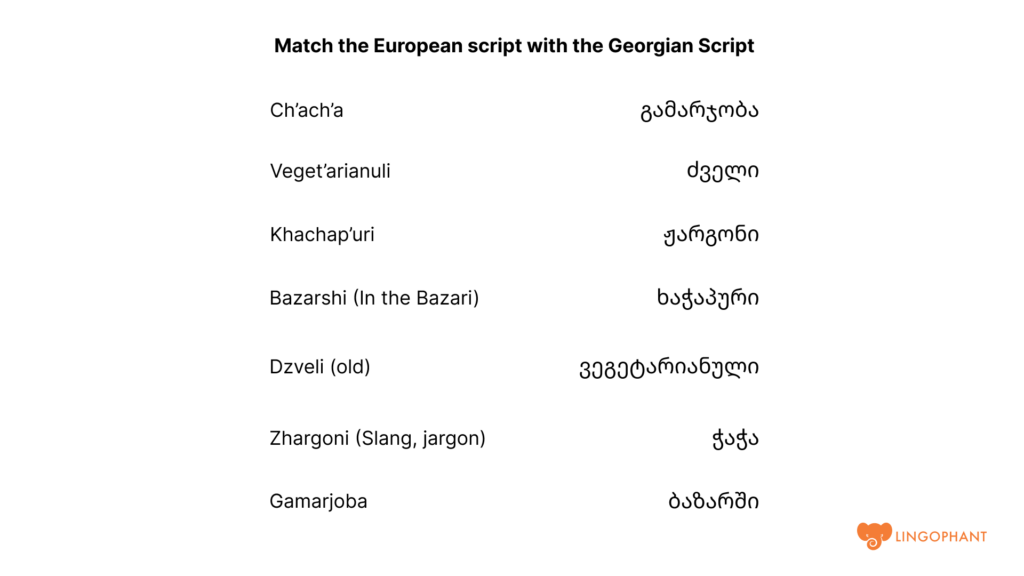
Practice hearing and distinguishing the sounds
Recognizing ejective and normal letters is tough. So Lucas recorded words with two similar sound. And you can try to hear the difference And It’s an easy phraseset that may help you very much with this listening skill.
Download the app, create an account, and unlock the set below in the app.
If you want to practice writing:
In our experience it’s enough to write every letter 10 times, and then start copying a small text.
This way, in just a 1-2 hours, you will have learned how to write in Georgian.
Hint: you can save the image with a right click to your computer or phone for later review.
Then add it to the note that contains your other Georgian content as well.
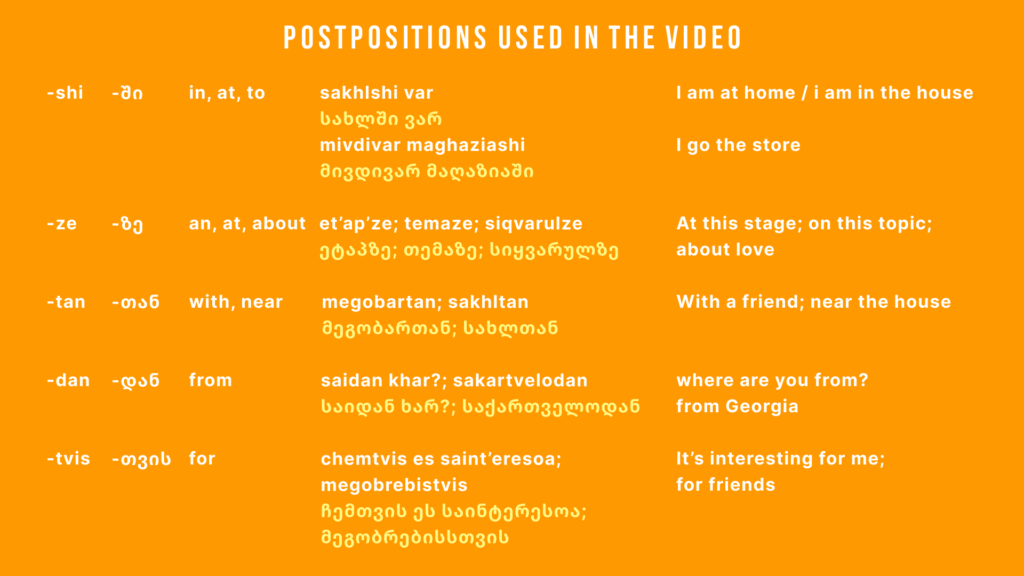
🧑🏫 Intro to verbs and locational suffixes (Saying “in, on, with, etc.”)
Let’s touch the most basic
grammar concepts.
We conjugate one verb.
And then we look at the v- and m- group real quick
(more coming later).
And finally, we talk about
postpositions of location.
Here are all of them. You can screenshot / download it and add
it to a Georgian photo album with all your useful screenshots 😇
📔 About memorizing phrases with our app
For the same results, would you prefer to spend:
- 🚶 1-hour with slow comfy learning?
- 🏃 Or 20-minutes with intense learning?
We prefer intense learning.
Also, we prefer personalised learning.
Record people that teach you new words and practice with their voice. Build your own vocabulary!
And most importantly: build a routine! Make it automatic to practice every day and you won’t have to think about it anymore.
Here’s a video that explains more about the app:
Anyways. Download our app on the App Store and the Google Play Store and you directly access this page from there.
📔 In-depth explanation of basic phrases (with practice set)
Here are basic phrases with some explanation.
Watch this video once, and then memorise them with our app. First create an account, and then unlock the phraseset with the link below. Now you can download them to your phone.
Our free app uses voice recordings by a human person so you don’t vocalize words using your native language.
🎧 About training your listening skills
The people in the course team have studied 15+ languages, and this is the best method :
Watch content with double subtitles multiple times to build listening skills.
In Georgian, however, this method is impossible, due to the script and availability of subtitles. So we made our own content with readable subtitles that you can watch and rewatch.
Soon, you’ll have listened to thousands of words, understood the meaning, and get a feeling of what natural speech is like.
Let’s start.👇
🎧 Listening-reading: Understand Ira’s stories about traveling and her designer career.
Meet Ira, a great person and friend of ours 🙂
To show you how this listening-reading method works, we have created 30-minute versions of it. You’re rewatching each part a few times.
You can then repeat the process with the other videos we made by yourself.
You can also use the audio player and it should play in the background or if you like writing on printed notes, we have a pdf that you can download and print to play with while listening.
Here are the 30 minute follow-along versions
Watch this 36 minute version, it tells you what to focus on. The come back on another day for the second session.
Your second time watching and reviewing. Understanding more already? Come back on another day for the third time.
And the third time now. Let’s see also how much you’ll understand without subtitles.
And here full original source videos.
And here is audio and pdf.
🧑🏫 Verb shorts part 1/4: Six videos about history, the verb blocks, tenses, and verb endings.
We shared these videos for free on our Instagram page, so follow us if you want them to randomly show up.
Here we share them in sets of 5-6 to watch at once.
With just a few short videos each week, you will learn how the most complex part of Georgian grammar works: the verb system.
Above is some historic context. 1600 years ago the Georgian script appeared in Georgia, and 60 years later already in Bethlehem! Isn’t that cool?
Introducing the block system in the video above.
Thinking of verbs like this will help you understand them.
Let’s introduce each block one-by-one now. The blocks will have a separate video later.
Now we take a look at the tenses in Georgian.
There are more, but we selected the 5 most used ones, and explain how they relate to each other.
Now let’s settle this knowledge by going through some examples.
We’ll start with the same video next week. It’s just for you to see the different blue blocks in action.
🏁 That’s it ! Next week another set of shorts 🙂
✅ That’s it for your first weeks.

We hope you can see how we’re trying to make natural learning more efficient. Condensed information, that you can rewatch and recognize the patterns while practicing. Research really says that input and automatic output are the best ways to learn.
Also, join our WhatsApp group to benefit from reminders and conversation sessions.
https://chat.whatsapp.com/LjnXpLsJjQP0oRdQzZ42im
And if you have feedback, we would be happy to hear it 🙂 Use this link. Thanks
Week 3+4
🎧 Listening-Reading: Review old videos.
Welcome to week 3 and 4, we hope you enjoyed the first part.
Let’s start by listening to Ira to check if you can already understand some words. Even if you just understand 10% that is already an improvement!
You can also rewatch her videos above, if you’re not ready yet.
And since it’s audio, you can maybe listen while doing something else. After rewatching her videos, it’s much more comfortable to just listen and it also works better. You can first read through the script or just listen directly.
Enjoy!
🧑🏫 Morphology, our must-see overview!
After watching this video, Georgian words became a lot more logical and you can see their beauty. It explains the main concepts in 14 minutes, so feel free to rewatch it later!
Georgian is based on roots and morphing rules. That’s how you end up with long words.
When you know the patterns, you remember roots and patterns, instead of long scary words.
Enjoy!
Got feedback? Please use this link. Thanks!
🎧 Listening-Reading, with lovely senior Mzia from Tskaltubo
Do the same as with Ira:
- Watch it multiple times,
- Put the link in a note for quick access,
- Write words you want to remember under the link,
- Come back in the future, read the words, and watch it again,
And after a few practice sessions you’ll also understand her story with only the audio. It really helps you brain recognize and separate words in the sound Kharcho.
And here’s a wonderful second listening video from Mzia. Get to know someone who was working in a Soviet Sanatorium, and then had a peaceful life afterwards. With some fun facts about post-war Georgia and Georgian “Boomers”.
Got feedback? Please use this link. Thanks!
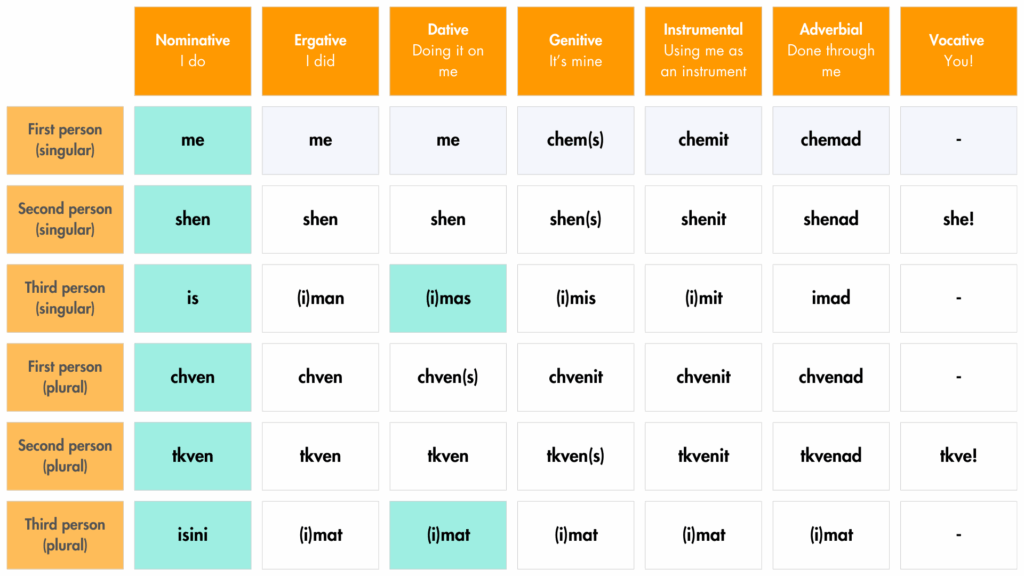
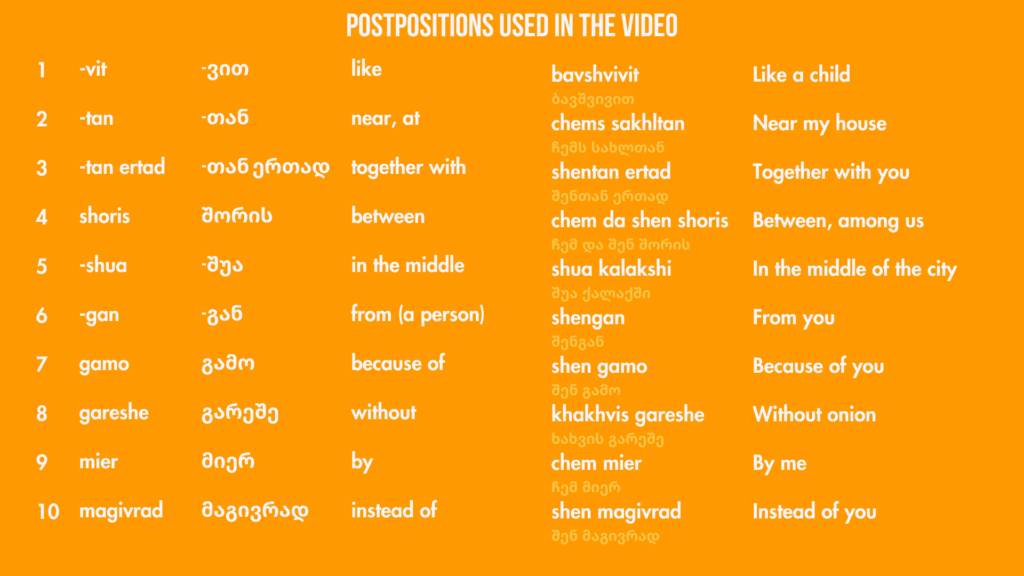
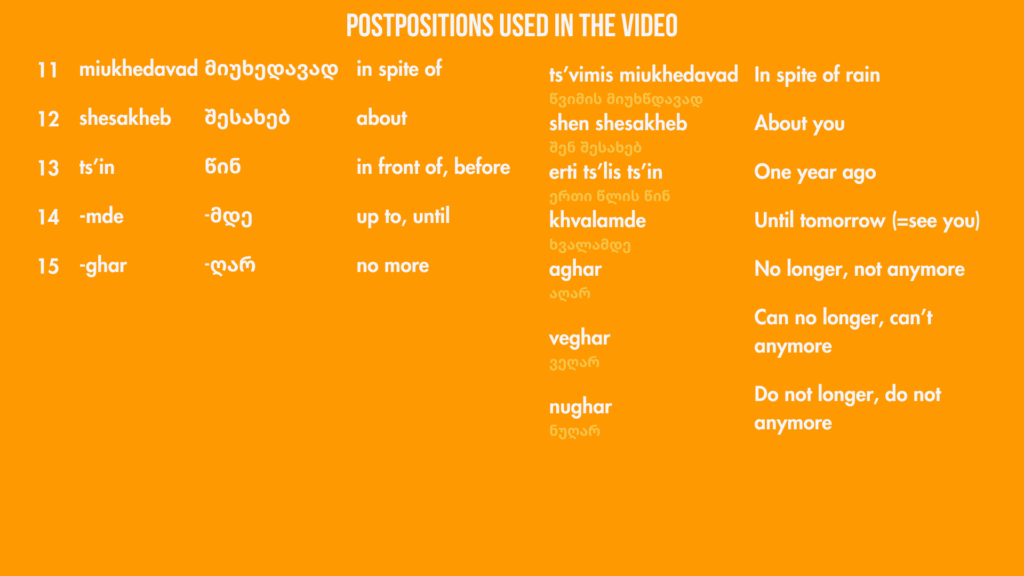
🧑🏫 Pronouns, Conjunctions, and Negations
Pronouns are used
to relate to other people.
Conjunctions are mainly
used for locations and logical relations.
Both are very useful!
Overview of pronouns
Overview of Conjunctions
Got feedback? Use this link.
🎧 Listening-Reading, with lovely senior Guram from Tskaltubo
Here’s Anzori (nickname Guram) speaking with a strong imeretian accent.
No worries about understanding everything. We marked the standard verb blocks that you’ll learn about in the verb shorts in colors, as well as the suffixes. That way you can recognise these directional and temporal standard patterns.
We recommend watching these videos multiple times.
Put the link in a note on your phone. Next time you’re on a bus, review it and build a natural understanding of the language.
And here’s the audio file and pdf if you prefer that.
⚡️Practice Phrases
The is just your reminder that at some point this week,
you should have your available phrases down to 0.
Words and phrases come back over time when you’re about to forget them.
So check in every day to see if there are new words and soon
you’ll know many useful sentences by heart
It’s the number you see with the cheese
(for Georgian) on the practice screen.
There are some more sets of phrases coming this week.
📔 Phrases for at the Bazari
And here are 17 Phrases for at the Bazari. Get them onto your app, practice them, and use them the next time you’re shopping.
Got feedback? Please use this link. Thanks!
📔 Phrases to help you ask for clarification
you can download the phrases to your phone and practice them efficiently. There’s no way around practicing. We can only make it faster by being efficient with our app 🙂 And soon you’ll know another set of correct phrases to use.
Got feedback? Use this link. Thanks!
🧑🏫 Verb shorts part 2/4: Videos about the tenses
Hey, we shared these videos for free on our Instagram page,
but here they are for you to watch them as part of our course.
With just a few shot videos each week, you will learn how the
most complex part of Georgian grammar works: the verb system.
Let’s take a look at the tenses in Georgian.
There are more, but we selected the 5 most used
ones, and explain how they relate.
Let’s take a another look at
the tenses in Georgian.
These are the blue blocks. Preverbs in the beginning, and suffixes at the end. There is a present / future ending. And the aorist past and the optative have a special ending.
That’s it.
What are those preverbs again? And how to remember the correct ones for each verbs?
Verbs are unique by their root, their verb family (which is the blue suffix) and their preverb (the blue prefix).
And now our favourite video:
the directional preverbs.
Learn in 2 minutes what you will need for every verb (in the future or past, hehe).
This is the most important part, and can help visualize verbs when trying to remember them. Maybe watch this video a few times?
The key here is that the infinitive
can also be a noun.
The next video is that every
verb has a simple root.
Regarding the example of va-p’ir-eb (I plan on doing something)
P’iri is mouth, you’re giving your word / mouth in Georgian.
It’s also the root of promising something, but then it gets a -d- at the end: gp’irdebi.
So yeah, let’s finish with the verb root, which every Georgian verb has.
Recognising verb roots is the #1 skill required for Georgian. It’s also what makes verbs irregular, because some verbs change roots between tenses.
We have a 13 minute morphology video that talks about roots in detail. We mentioned “Dap’ireba” last week, right?
Got feedback? Use this link. Thanks!
✅ That’s it for the second part.
We hope you’ve had some “aha” moments. By now, words should start to make a bit more sense, and you might recognize some words people are using. Research really says that we can only make natural learning more efficient, and that’s based on input and output practicing.
And again, join our WhatsApp group to benefit from reminders and conversation sessions.
https://chat.whatsapp.com/LjnXpLsJjQP0oRdQzZ42im
And if you have feedback, we would be happy to hear it 🙂 Use this link. Thanks!
Week 5+6
⚡️Practice phrases and review Listening-Reading. Also this week 😉
Don’t forget to practice phrases on your app. The best occasions are:
- In public transport
- When walking somewhere
- On the toilet
- When waiting for someone
- While doing sports
- Before going to bed
Also, you should practice listening and recognizing words some more. You can go back to the videos from last week, or just listen to the audio below.
Do at least 30 minutes of listening-review this week.
You can also rewatch the video with subtitles upstairs if you don’t
feel ready yet for just listening. Both are very effective methods.
💡 Somehow reviewing a video you already watched
with audio works really well while doing something else.
🧑🏫 The Cases System
The case system isn’t thaaaat complicated, we did manage to cover the whole system in less than 12 minutes.
You’ll get used to it when practicing phrases or reading texts or listening to people. But with this knowledge you will recognize them when you need it 🙂
Got feedback? Please use this link. Thanks!
📔 Phrases for Introducing Yourself (with a practice set)
Use the above link to unlock the phraseset on your account and practice regularly:
• On the bus / metro / train
• Before going to bed
• In the bathroom
• While taking a walk
Got feedback? Use this link. Thanks!
🎧 Listening-Reading with tin crafter Soso.
Soso is a tin crafter, who lives in Kutaisi. He builds metal structures for houses in old unique styles, for example for water pipes. A former volleyball player and a coach, now he is a crafter and he talks about his experiences, when he started, work he does, what he likes, etc.
Got feedback? Please use this link. Thanks!
📔 Phrases for talking about learning languages (with practice set)
With the following link you can unlock the phraseset on your phone,
download them, and practice them whenever you have a moment.
Got feedback? Use this link. Thanks!
🎧 Listening-Reading with Lukas (1/3). Some stories from his life.
Let us introduce Lucas to you, who already speaks very fast.
Well, that’s how it is with Georgians. Some cannot speak fast.
His real name is Anzori, but names
and nicknames are not always the same.
Still, it is good practice to listen many times.
And after a few times on a few days you can soon
understand this fast speaker too.
Good luck and enjoy that you’re able to understand something.
Even if it feels like nothing. It is working subconsciously.
🎧 Listening-Reading with Lukas (2/3). Listen to his daily routines
🧑🏫 Verb shorts part 3/4: The Verb Root, Subject and Object Markers,
Version Markers, and a teaser of the future tense.
After these six shorts, you will know how to create a declined verb that
contains three “persons”: the subject, the object, and a version marker
that can direct the action towards something or someone.
How to mark the person doing something?
Usually with a Subject Marker, which has the
-v- ending for the first person.
Don’t hesitate to take a screenshot during the video.
Up next, the Object Markers.
They start with -m- for the first person.
And -g- for the second person.
I promise you is g-p’ir-d-ebi.
They indicate a second person or
object on which an action is performed.
However, some verbs use the Object Marker to show the acting person. Like in Spanish, me gusta. Something is liked by me.
The next videos continue with verb versions.
We can change the meaning and direction of verbs also with a Version Marker.
This way we can have a reflexive “-i-“ version of the verb. Or “-a-“ and
“-e-“ that are directed at another object.
What if we combine Subjective, Objective, and Version markers?
We can have verbs with up to 3 actors / objects!
But there are some rules about this in the video above.
Let’s look at some examples that will tie it all together.
This is how verbs work in the present and future tense, including subject, and object markers.
And now a first step towards the past forms, with the simple imperfect, that just adds -di to the present verb.
For things that continued for a longer time in the past, we use the Imperfect Past.
Got feedback? Use this link. Thanks!
✅ That’s it for the third phase.
We hope you’ve learned something. And research really says that input and automatic output are the best ways to learn.
Also, join the WhatsApp to benefit from reminders and conversation sessions.
https://chat.whatsapp.com/LjnXpLsJjQP0oRdQzZ42im
And if you have feedback, we would be happy to hear it 🙂 Use this link. Thanks
Got feedback? Use this link. Thanks!
Week 7-8
🎧 Practice reading out aloud with Ira’s video
Welcome to the last part. After this you’ll have a great overview, and continuing learning will be much easier. Don’t forget you can also re-watch previous parts, as it’s quite condensed and you might need some time to process.
After this part, you have all the tools to be successful. Go out there and record words. 400 phrases and you can express yourself, then 1000 phrases and you have relative fluency.
Let’s start by training the “muscle memory” of your mouth by actually speaking.
*Audio is lower for reading along and slowed down to 80%.
Read along with this video.
If you found this useful, let us know and we can create more content like this. Georgian subtitles on YouTube exist for some videos and we’ll gradually add more sources to the Bonus material below.
Want to request more content? Please use this link. Thanks!
📔 Phrases for expressing likes and dislikes (with practice set)
Open the phraseset on your mobile device and add these phrases to your phone for practicing anywhere.
Got feedback? Please use this link. Thanks!
🎧 Listening-Reading with Lukas (3/3). Let’s talk about traveling and advice for foreigners
Another video of fast-talking Lucas. Watch it multiple times until you can recognize words better. Recognizing words in general is pretty difficult and it’s really normal if it’s hard. As long as you’re paying attention, your brain is already learning. Take it easy 🙂
Got feedback? Use this link. Thanks!
📔 Phrases for Opinions and Preferences (with practice set)
With the link above, you can download the phrases from the video to your phone and add them to your practice routine.
Got feedback? Please use this link. Thanks!
🧑🏫 Verb shorts part 4/4: Version markers, the imperfect, and the aorist tense
The final videos continue with the more difficult and complex tenses.
There’s the aorist, which is like the simple past. There are two versions, one with a pre-verb and one without, that uses an -i- instead. The same pre-verb is used with the future and the optative tense. And every verb has a specific pre-verb that shows some directional meaning as well. Ga- means outwards. Ts’a- is like forward. She- is like inside. etc.
Let’s start with
the Aorist, the unspecified or simple past.
There’s another way to recognise that something happened in the past.
The acting person ends with -ma, and you already know it happened in the Aorist past.
Like if the sentence starts with “Alexma mitkhra”, -> Alex told me.
-ma -> past sentence.
To not confuse you with other versions, we’ve kept another way of creating
the past and future.
One is with pre-verbs.
The other with an -i- which looks simpler but can be confused with a reflective version marker.
Usually it’s used for actions that go without an object. Done by themselves. Intransitive.
What makes verbs irregular?
Usually they have different roots
in the present, future, and past tense.
Also sometimes they don’t
decline the normal way.
It has nothing to do with the meaning changing with different preverbs.
It’s more like not behaving
according to rules.
Let’s look at some irregular examples.
Very important are verbs of movement. You can go rewatch the directional preverbs video that we filmed on the Bagrati church hill of Kutaisi to see how you can remember them.
But in general, here are how to create verbs of movement.
And our last video is about the optative. Then we’re done.
The optative shows optionality, and you’ll see it most commonly used with minda.
Though some people told me they always use the infinitive. But this is the most elegant and for now advanced part of the verb system.
We hope you liked them and that you will recognize the patterns!
Got feedback? Please use this link. Thanks!
🧑🏫 62 Georgian phrases in one pdf for you to download !
As a reward for finishing all the verb shorts:
Here are 62 Georgian verbs in one pleasant pdf:
Got feedback? Please use this link. Thanks!
🎧 Listening-Reading: We subtitled a 30-minute episode of the famous show Chemi Tsolis Dakalebi
It kind of resembles Desperate Housewives by the concept, but a bit more Georgian and less desperate. You can find the rest of the episodes here (but without subtitles)
You could write your own transcript of the next episode, with help from Google Translate and running YouTube at 75% of the speed.
In general, watching them at 75% speed is a good idea.
Enjoy 🙂
Got feedback? Please use this link. Thanks!
✅ That’s it for the last part.
You’ve made it! final week of your journey! We hope you enjoyed it and made immense progress in learning new language.
Enjoy our recommended bonus materials.
And donate some moneys. We spent a whole year on creating this material and haven’t even made 1000€ from it yet.
Bonus Material
Recommended Georgian movies with subtitles
Sadly, there are barely movies with official Georgian subtitles. We have selected movies where at least English subtitles are available. Still enjoyable though, and you can connect sounds and meanings!
In general, we can recommend a subscription to Cavea Plus. Though you might need a VPN that can simulate being in Georgia if you live abroad (Protonvpn has a paid one).
Monanieba / Repentance (1984-1997)
Watch on Youtube
Watch on RareFilmm
Movie was made in 1984 but aired only in 1987 because it was censored by Soviet authorities.
Varlam, the despotic mayor of a small town, dies. After his funeral, his body is repeatedly unearthed and buried again. Through flashbacks and dreamlike scenes, we witness his rise, power and ambiguities.
Pirosmani (1969)
Watch on Youtube
The story of self-taught Georgian painter Niko Pirosmani.
Ekvtime ghvtisk’atsi / Ek’vtime: Man of god (2018)
Watch on Youtube
Watch on Cavea+
In February 1921, when the Soviet Red Army invaded independent Georgia, the government decided to collect all the treasury property and museum treasures and flee to France in emigration. They entrusted Ekvtime Takaishvili to collect the treasure and appointed him as a guard. The film’s story is about hard life and activities of Ekvtime Takaishvili which mainly includes the history of the protection of the treasury in France during the emigration period in 1921-1945 and how Ekvtime Takaishvili returned it. The film is accompanied by the love story of Ekvtime and his charming wife and companion Nino Poltaratskaya. Ekvtime himself defended the Georgian treasure from the world famous museums, rich collectors, court disputes, criminals and fascists to endure all the temptations and never deviated from the supreme moral principles and love of the Motherland, what is eternal in this world. In 2002 the Georgian Holly Church canonized Ekvtime Takaishvili and named him as „Man of God“.
Grdzeli nateli dgheebi / In bloom (2013)
Watch on AppleTV
Watch on Cavea+
Early 90s, in Tbilisi, the capital of the newly independent Georgia after the collapse of the Soviet Union. The country is immersed in violence – there’s a war on the Black Sea coast in Abkhazia, and vigilante justice plagues society. But for Eka and Natia, fourteen-year-old inseparable friends, life just unfolds in the street, at school, with friends or Eka’s elder sister. Although they are already dealing with men’s dominance, early marriage and disillusioned love, for these two girls in bloom, life just goes on.
Chemi bednieri ojakhi / My happy family (2017)
Watch on Netflix
Watch on Cavea+
Manana, middle aged woman, decides to leave her family, husband, children, and parents. The reasons and rationale for her decision are initially and largely unknown to her family, and remain mysterious to them throughout the story. Her perspective, however, is slowly disclosed to the audience. Manana’s decision to challenge the social expectations of women in her community gives My Happy Family a feminist streak.
Mandarinebi / Tangerines (2013)
Watch on AppleTV
Watch on Cavea+
Movie was nominated for Best Foreign Language Film at the Oscar 87th Academy Awards (2015)
During the war in Abkhazia, an Estonian man stays behind to wait for his crop of tangerines. After a firefight he must care for two soldiers, each from opposing sides, who each vow to kill the other once they recover. Two men with very different personalities, upbringings, and values: one Georgian, one Chechen, living in Estonian Ivo’s house. Ivo is the definition of a good man, he’s wise, he’s kind, he’s caring and he somehow unites the two sworn enemies to the point they sacrifice themselves for each other. There are no winners in a war, that’s the main idea behind this film. It revolves around morals, patriotism, kindness and what it means to be human.
Da chven vitsek’vet / And then we danced (2019)
Watch on Hulu
Watch on Cavea+
A passionate tale of love and liberation set amidst the conservative confines of modern Georgian society, AND THEN WE DANCED follows Merab, a devoted dancer who has been training for years with his partner Mary for a spot in the National Georgian Ensemble. The arrival of another male dancer, Irakli—gifted with perfect form and equipped with a rebellious streak—throws Merab off balance, sparking both an intense rivalry and romantic desire that may cause him to risk his future in dance as well as his relationships with Mary and his family.
Meotkhe brait’oni / Brighton 4th (2021)
Watch on Amazon Prime
Watch on Cavea+
In this portrait of parental sacrifice and the love of a father for his son, former wrestler Kakhi embarks on a journey from his home in the Republic of Georgia to visit his son Soso in the Russian-speaking neighborhood of Brighton Beach, Brooklyn. There he finds him living in a shabby boarding house populated by a colorful group of fellow Georgian immigrants. Soso is not studying medicine, as Kakhi believed, but is working for a moving company and has accrued a $14,000 gambling debt to a local Russian mob boss. Kakhi sets his mind to helping his hapless son out of his debt, leading to situations as often comic as they are dire.
Official Georgian Textbook
Aghmarti / Ascent
This is the standard book being used by most teachers and it has some nice resources as well. You’ll see that with the practice you have from this course you can go through it pretty quickly. Ideally, we recommend that you have one weekly hour with a private teacher. Half an hour of going through the book, and half an hour of conversation where the teacher records phrases based on things you tried to say. That way you learn 20-30 new phrases every lesson, and you work your way through the grammar (though there’s not too much left after this course, yay!)
A1 level material
A2 level material
A2+ level material
B1 level material
B2 level material
B2+ level material
C1 level material
Recommended Youtube channels
Zmuki podcast
Watch
Zmuki is a podcast about the Georgian music scene. Georgian music is a hidden gem of the music world. Zmuki podcast uncovers stories and perspectives that were previously unknown, with active musicians talking about everything music lovers want to hear. We highly recommend listening to both Georgian music and this podcast.
kuchebi ar ivits’q’eben / Streets won’t forget
Watch
“Kućebi ar ivits’q’eben” is a podcast series about football teams during their unforgettable runs, such as Leeds United 2000/01, Parma 1998/99, FC Barcelona 2005/06, and more. It is a very interesting, informative, fun, and nostalgic podcast. You will enjoy it even if you don’t like the beautiful game.
Giorgi sakartvelodan / George from Georgia
Watch
Giorgi is one of the most interesting YouTube travelers from Georgia. He takes you to very interesting places, has thoughtful conversations with people, and gives you perspectives on events and life that most travelers don’t and can’t.
Monolith Records podcast
Watch
This is a Monolith Records podcast where you will get to know the artists better behind the scenes, what they do in their personal lives, how they create their music, and you will hear advice from them for aspiring artists.
Soso msoplios irgvliv / Soso around the world
Watch
Soso is the most popular YouTube traveler in Georgia. You can watch his travel vlogs in Georgian from Svaneti, Racha, and Lechkhumi, as well as from abroad, including North Korea, Africa, Brazil, and more.
🤓 Continue by recording your own phrases (with friends or private lessons)
How to continue? You can go out and create app recordings whenever you learn you a new word or expression. Then you’ll practice with the voice of the people you met.
The most effective way is to have private lessons, using our app. After 10 lessons with 30 new phrases each, you’ll have 300 phrases more! That’s enough for basic conversations, expressing yourself with native speakers, and throwing out some funny comment or slang sometimes.
We have a network of teachers that work with our app and are happy to sell you a 5-lesson pack for 75€ (all the money will go to them). Ask us on WhatsApp, send us an email to team@lingophant, or text us on Instagram @lingophant_geo and we will connect you to a capable and suitable teacher.
Good job on finishing. And this is just the beginning of a beautiful journey of speaking Georgian.
🙌
Again, if you found it valuable and please recommend us to a friend and support us financially 😇.
Support us back!
You can not imagine how much time we have spent on this in the hope of saving you many hours of frustration.
We’ve not even made 1000€ from this, so donate and it will go back to the course creators. Think of the time and energy we’ve saved you, and then give us back a little bit of that.